


You know those “ah-ha” moments? You’re chatting with a colleague, casually sharing ideas. Then, boom! Clarity. Maybe you figured out a solution to an old problem, or an idea for your new product.
This clear direction and alignment can be incredibly motivating. A moment of insight among your product development team can resolve key uncertainties, align team efforts, and boost overall motivation.
But how do you make sure you have a rock-solid process? Ideas are great, but your product team needs a great product development process to be successful. This article covers how a team might build on your brilliant ideas for a seamless product development journey.
Key highlights:
- Learn the seven essential phases of new product development
- Overcome common product development challenges
- Apply new product development techniques
- Collaborate cross-functionally throughout the product lifecycle
What is a new product development process?
New product development refers to the journey from ideation to the introduction of a brand new product in the market. It’s a structured approach that brings concepts to life, with the goal of meeting specific customer needs. Whether you’re creating physical products or software, you can minimize risks and maximize success with a super-clear process.
While working with your team on new product creation, it’s especially important to have an organized process when your team is facing complexity or growth. And let’s face it: When aren’t things at work feeling complicated and moving fast?
New product development processes are especially important for product managers who want to make a product go from nothing to something that works. But of course, it can be valuable regardless of your product’s stage of maturity.
Related: Collaborate with stakeholders on your product development strategy
Types of new product development
Your approach, products, and market can take various forms, so here are some examples of types of new product development:
{{prod-dev-process="/utility/styleguide/cms-tables"}}
Common challenges with new product development
Why is new product development so difficult? Well, 30,000 new products are launched into the market each year, but most fail, according to Harvard Business School. Here’s an overview of common challenges:
- Strategic alignment: Keeping development in line with company goals is tough without regular check-ins. Your team has busy schedules and tight deadlines, and there’s not always time to connect.
- Scope creep: Ah, scope creep. Changes can quickly derail projects and blow your budget. Additional features, tasks, or deliverables are added to a project, and your plans are now off track.
- Speed vs. quality: Rushing can compromise quality, but moving too slowly can miss opportunities. Finding a good balance is tricky.
- Resource constraints: Limited resources means prioritizing tasks and being flexible. You need efficient management, but that’s easier said than done.
- Market timing: Launching at the right time is crucial, but timing isn’t always in your control. Simple products might take three months, while complex physical products can take three years or more. Lots of factors will influence your timelines.
Sar Ashjian, Sr. Product Manager at Mural, shares how she tackles common new product development challenges with collaboration:
“New product development can be challenging because we don’t work in a vacuum! Like a seed needs sunlight, water, and nutrients to grow into a fruitful tree, successful products require collaboration across diverse teams and perspectives.
Mural is the collaborative and asynchronous digital home where I plant product ideas and watch them grow. I invite all stakeholders to a shared space to work together openly, which encourages cross-pollination of ideas, unbound ideation, and transparent feedback.”
7 phases of new product development
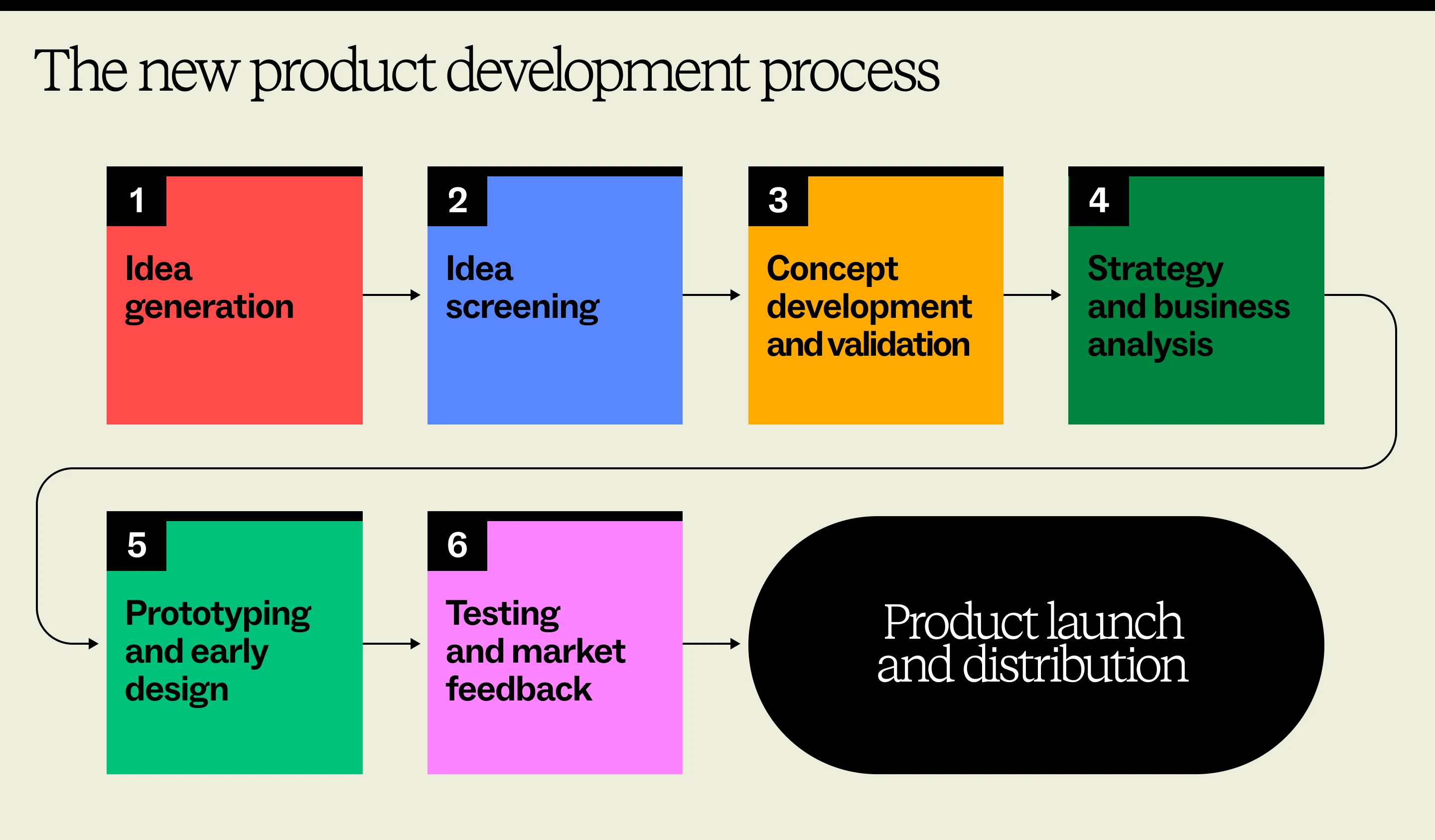
A new product development process is where innovation meets execution, transforming abstract ideas into solutions that resonate with customers. Here are seven stages of new product development, with tips for a more visual and collaborative process.
1. Idea generation
Create a pool of potential product concepts through brainstorming, market research, customer feedback, and competitive analysis. Successful teams capture these ideas continuously through dedicated sessions and advisory boards.
Tip: Use brainstorming templates to facilitate creative idea generation sessions to support your product vision visually and interactively.
Related: 10 ways Mural AI enhances product innovation and speed to market
2. Idea screening
Evaluate and prioritize ideas systematically. You’ll want to assess concepts against criteria like strategic fit, market potential, and technical feasibility. Try using scoring matrices for objective evaluation, but keep your gut instinct balanced with data.
Tip: Mural’s product comparison template can help your team screen ideas systematically and collaboratively.
3. Concept development and validation
It’s time to define and test promising product concepts. Create detailed descriptions, visuals, and prototypes to communicate the product’s essence. Validate through customer interviews, surveys, or focus groups before committing major resources.
Tip: Try a prototyping template or even a Concept Poster, and gather feedback in real-time. Sar recommends the following approach to gathering honest input:
“One of my favorite features in Mural is Private Mode, which helps create a psychologically safe space where stakeholders, contributors, and collaborators can provide candid feedback, respectfully challenge consensus, or address the “elephant in the room.” This ensures we’re building products that truly address user needs, rather than just the most vocal or popular opinions.”
4. Strategy and business analysis
Make sure your product concepts are financially viable and strategic. Take a look at market size, competition, revenue projections, costs, and ROI to build your business case.
Tip: Use the product prioritization template to make your strategic and financial planning more collaborative.
5. Prototyping and early design
Now for the fun part: creating tangible prototypes to bring your concepts to life! This stage of new product creation can range from simple mockups to functional prototypes. Aim for rapid iteration to test assumptions quickly.
Tip: Mural’s visual collaboration features enable quick prototyping and iterative design for continuous improvement.
6. Testing and market feedback
According to Salesforce, 63% of consumers expect businesses to know their unique needs, so thorough testing with target users will validate your market needs. Evaluate functionality, usability, and customer experience through usability studies, beta programs, or market trials. And for your final adjustments, quantitative metrics and qualitative insights are needed.
Tip: Use Mural to visualize testing phases and gather market feedback collaboratively with the feature market analysis template.
7. Product launch and distribution
Launch time! The last step in the new product development stages involves coordinating your efforts across marketing, sales, support, and operations for a successful launch. Plan your promotional activities, prices, ways to get your product out there, and how customers sign up. Make sure your post-launch monitoring helps you track how people use it and give feedback so you can fix problems quickly.
Tip: Mural’s product launch template helps your align your efforts.
How to design a new product development process in Mural

I’ve shared several templates on how to start product development processes, but if you want a one-stop shop, Sar’s favorite is the strategy blueprint template. Here’s her advice:
“A zoomed-out strategic view, no matter how small the project, helps the team understand the bigger picture and the reason behind our efforts. The strategy blueprint serves as an essential map to guide our journey. Without our map, we can easily get lost in the details, wander off course, or lose sight of what matters most.
I recommend dedicating time to collaboratively build a strategic map before diving into execution. The process itself creates alignment and builds shared ownership. As you progress, you can return to the map to check your bearings and course correct. Even as the terrain changes (and it will), this foundation will help you navigate through uncertainty and help keep the team moving in a unified direction.”
A complete new product development plan brings together stakeholders around important goals. You can change and add to your plan with Mural’s pre-built templates and features. Make sure to:
- Define objectives and success metrics: Try templates like the phased release plan or product roadmap, and use sticky notes or text to list the objectives and success metrics for each phase.
- Set roles and responsibilities: Assign tasks to specific team members using sticky notes in an action plan or RACI template, and use icons or avatars for representation. Allow team members to add comments or suggestions on their roles.
- Set timelines and milestones: Create a timeline frame on your board using a template like the one-year roadmap. Mark key milestones along the timeline using icons.
- Build feedback mechanisms: Try Mural's Voting feature to gather team input and feedback, and track feedback and lessons learned with a simple LUMA method like Rose, Thorn, Bud.
- Identify risks and mitigation strategies: Identify potential risks associated with each phase using a risk probability matrix template.
- Outline decision-making processes: Use flowcharts or diagrams to illustrate decision-making steps, responsibilities, or save time and use this decision tree diagraming template.
With Mural, your team can collaborate in a structured way, visualizing your product development process steps, tracking progress, and quickly iterating based on everyone’s input. A collaborative approach to work also helps align stakeholders and ensures accessibility and clarity for all.
{{talk-to-sales-demo="/cta-components"}}
Techniques for effective product development
To nail your new product development process, it’s essential to mix tried-and-true techniques with smart best practices. Consider which approach you might use alongside your newly designed process in Mural.
- Design thinking: Get everyone on the same page by stepping into your customers’ shoes with design thinking.
- MVP approach: Start simple by delivering the core value first. Release a basic version of your product and gather feedback to iterate quickly. Prioritize what matters.
- Feedback loops: Keep refining your product with constant feedback. With visual collaboration, you can incorporate that feedback in real-time, so you can make informed decisions.
- Rapid prototyping and testing: Validate your ideas quickly with prototypes. Create and share your ideas easily in Mural, ensuring your product meets user expectations.
- Automation and AI: Use Mural AI to for seamless integration. 75% of software engineers in large companies will use AI for coding by 2028, according to Gartner. Get used to working with AI for your product development, along with human collaborators.
- Cross-functional teams: Bring diverse perspectives together from start to finish as you develop a new product.
- Jobs-to-be-done framework: Understand what problems your customers are really trying to solve. Mural’s jobs to be done template guides your team to uncover these insights.
Sar’s approach to understanding jobs to be done involves LUMA’s human-centered design method, the Contextual Inquiry template.
“When I interview developers versus when I observe these same developers working in their local environment, the feedback I receive is world apart. Watching their real workflows reveals pain points they’ve normalized or couldn’t articulate.
Contextual inquiry helps structure these observations, capturing both explicit and implicit needs. The approach helps me prioritize platform improvements that genuinely improve developer productivity, rather than features that sound good in theory.”
Related: How to create better team alignment
Best practices for new product development

As you create your new product development strategy, always keep your customers’ needs front and center. You’ll want to be ready to pivot based on new information and feedback. Work in a flexible, collaborative space like Mural so your team is always on the same page.
Keep the project on track with routine check-ins so you can tackle any issues early. If you spot potential risks and have a plan to mitigate them, you’ll save yourself from headaches down the road. Finally, cultivate a culture of improvement with regular retrospectives. Measure your success using like:
- Speed from concept to launch
- Resource utilization and productivity
- Customer satisfaction
- Revenue, profitability, ROI
Related: 5 best practices for better group communication
Start your new product creation with Mural
With Mural, your product team can transform how they ideate, design, and deliver products. Use our templates and features to enhance creativity and accelerate development.
Chat with our team and request a demo to see how visual collaboration can improve your product development journey.
{{talk-to-sales-demo="/cta-components"}}


