Knowing how to improve teamwork starts with understanding what makes people work well together. Effective teamwork in the workplace depends on trust, clear communication, shared goals, and a common understanding of responsibilities. Whether your team works in person, remotely, or across departments, strong collaboration requires intentional effort.
To improve teamwork, start by establishing consistent communication practices, setting clear expectations, creating opportunities to solve problems together, and making knowledge accessible to everyone. These habits help teams combine their strengths, coordinate their work, and make progress toward shared outcomes.
Building a stronger team doesn't require overhauling every process at once. Small changes to how people exchange information, contribute ideas, and make decisions can lead to more productive and effective collaboration over time.
Why teamwork matters in the workplace
Effective teamwork brings together different skills, experiences, and perspectives to tackle challenges that individuals may struggle to address alone. When people understand how their contributions fit together, they're better equipped to coordinate tasks, solve problems, and support one another.
Strong teamwork also creates opportunities to build trust. As working relationships develop, team members become more comfortable asking questions, sharing feedback, and raising concerns before problems escalate.
Better teamwork can lead to several important workplace outcomes:
- Better communication: Team members exchange information, clarify expectations, and address misunderstandings so progress isn’t stalled.
- More efficient problem-solving: Different perspectives help teams identify potential solutions and evaluate tradeoffs.
- Clearer decision-making: Shared context makes it easier to understand priorities, evaluate options, and agree on next steps.
- Stronger working relationships: Consistent collaboration builds trust and awareness of colleagues' strengths.
- More consistent progress toward goals: Teams can coordinate responsibilities and keep their efforts focused on shared objectives while managing dependencies.
These benefits become especially important when work involves multiple departments.
Consider a product launch that requires engineering, marketing, sales, and customer support to coordinate their efforts. Each group has different responsibilities and priorities. Without effective teamwork, important dependencies may go unnoticed, decisions may be made without the right input, and teams may end up working from different assumptions.
A shared approach to planning and communication keeps everyone working toward the same outcome.
Cross-functional collaboration frameworks provide structure for coordinating work across departments, while a team charter template can help clarify expectations, responsibilities, and ways of working.
Effective ways to improve teamwork
Improving teamwork requires more than occasional team-building exercises or bringing people together for meetings. Strong teams develop everyday habits that make it easier to communicate, share expertise, collaborate, and follow through on commitments.
Here are five practical teamwork strategies you can apply in your workplace.
Set clear goals and expectations
When team members have different interpretations of success, even their best individual efforts can pull a project in competing directions.
Clear, shared goals give people a common purpose and a way to evaluate priorities. They also establish accountability by connecting individual responsibilities to the team's broader objectives.
Start by identifying what your team needs to accomplish. This might be a project milestone, a departmental objective, a performance target, or a larger business goal.
Then clarify five important elements:
- Priorities: Which outcomes matter most, and what work should take precedence?
- Responsibilities: Who owns each task, deliverable, or decision?
- Timelines: What deadlines and milestones should guide progress?
- Success measures: How will the team know whether it has achieved its objectives?
- Dependencies: Where does one person's or department's work affect another's?
For example, imagine a cross-functional team preparing to launch a new product within six months.
The shared objective establishes the destination, but each department needs to understand its contribution. Product and design might be responsible for validating customer needs, engineering for development and testing, and marketing for launch preparation.
The team should also identify dependencies between those activities. Marketing can't finalize certain materials until product decisions are confirmed, while development may depend on completing customer research or design reviews.
Making those connections explicit gives team members a clearer picture of how their work supports the larger goal.
One useful approach is to follow SMART criteria: Specific, Measurable, Achievable, Relevant, and Time-bound. Rather than setting an objective such as "improve the product launch," teams can define measurable milestones and a target completion date.
Use Mural's SMART goals template to establish objectives together, and revisit them regularly as priorities change.
For additional guidance, explore how to set effective team goals.
Improve team communication
Good communication keeps teamwork moving. Team members need to know how to share updates, raise questions, provide feedback, and find important information without relying on constant meetings or informal conversations.
Establishing clear communication practices can prevent duplicated work, missed updates, and conflicting assumptions.
Start by agreeing on how your team will communicate in different situations.
For example:
- Routine updates: Use a shared project space or asynchronous channel to communicate progress and blockers.
- Urgent issues: Establish a clear way to contact the right person when something needs immediate attention.
- Complex decisions: Bring relevant stakeholders together when an issue requires discussion, debate, or agreement.
- Feedback: Create regular opportunities to raise concerns, challenge assumptions, and suggest improvements.
- Decision records: Document important decisions, the reasoning behind them, and any resulting actions in an agreed location.
Choosing the right communication format is particularly important for hybrid and remote teams.
For example, a weekly status update may not require a meeting if everyone can review progress and flag concerns asynchronously. But when a team needs to resolve competing priorities or evaluate a difficult tradeoff, a live conversation may be more effective.
Building strong asynchronous communication practices also gives people in different locations and time zones opportunities to contribute without disrupting their schedules.
When meetings are necessary, make them purposeful. Effective meetings have clear objectives, relevant participants, and an agenda that focuses discussion on the outcomes the team needs to achieve.
To improve your meetings:
- Share the purpose and meeting agenda in advance.
- Invite participants to suggest discussion topics or prepare input.
- Make space for different perspectives rather than allowing a few voices to dominate.
- End by confirming decisions, action items, and ownership.
Teams can document their broader communication agreements in a team charter, creating a shared reference for how and when people should work together.
The objective is to make communication reliable and accessible, so team members can focus on solving problems rather than tracking down information.
Create opportunities for collaboration
Strong teamwork develops when people regularly contribute their expertise to shared challenges.
Informal activities such as team lunches, games, and icebreakers can strengthen personal relationships, but meaningful workplace collaboration also requires opportunities to solve real problems together.
Consider incorporating collaborative activities into your existing workflows.
Brainstorming sessions bring different perspectives into the creative process. Give participants time to develop ideas independently before discussing them as a group. This encourages broader participation and reduces the likelihood that the first or loudest suggestion will dominate.
Prioritization exercises give teams a structured way to evaluate competing ideas. Agree on criteria such as customer impact, feasibility, urgency, or effort, then assess options against those criteria.
Team retrospectives create opportunities to reflect on completed work, identify obstacles, and make improvements. Regular retrospectives encourage teams to learn from experience rather than repeat the same challenges.
Cross-functional projects connect employees with different skills and responsibilities around a common objective. Working through dependencies together can also help people understand how their decisions affect colleagues in other roles.
For example, imagine that a product team receives customer feedback suggesting improvements to its onboarding experience. Instead of having one department propose a solution independently, the team could bring together product, customer success, engineering, and design.
Each group reviews the feedback and identifies potential improvements. The team then clusters similar suggestions, discusses feasibility and customer impact, and prioritizes the changes it wants to pursue.
This creates a clear connection between collaboration and execution. These activities also strengthen important collaboration skills, including active listening, constructive disagreement, problem-solving, and incorporating feedback.
For larger initiatives, cross-functional collaboration frameworks can establish consistent approaches to ownership, communication, and decision-making across teams.
Share knowledge across the team
Even highly capable teams can struggle when important knowledge remains isolated within departments or individual employees.
Information silos make it harder to find answers, understand past decisions, and learn from previous work. They also create unnecessary dependencies when only one person understands a critical process or system.
Effective knowledge sharing makes expertise more accessible and gives teams opportunities to build on what others already know.
There are several ways to encourage knowledge sharing in the workplace:
- Document important processes. Maintain accessible instructions, project information, and resources so employees can find answers independently.
- Create peer-learning opportunities. Organize workshops, demonstrations, or lunch-and-learn sessions where employees share practical expertise.
- Support mentoring. Pair experienced team members with newer colleagues to transfer skills and institutional knowledge.
- Capture lessons learned. Use retrospectives and project reviews to document what worked, what didn't, and what should change.
- Maintain shared resources. Establish an agreed location for important information and make it easy for employees to contribute updates.
For example, after completing a complex project, a team might document the challenges it encountered, the solutions it tested, and the reasoning behind key decisions.
Those insights can guide the next project, help new employees understand established processes, and prevent colleagues from repeating work that's already been done.
However, creating documentation is only part of the process. Team members also need to know where to find it and whether the information is still reliable.
Assign responsibility for maintaining important resources, use consistent naming and organization practices, and review documentation when processes change. When possible, link information directly from the workflows where people need it.
Over time, these habits support stronger teamwork by reducing information silos and making collective expertise available across the organization.
Use tools and resources that support teamwork
The right tools can reinforce good teamwork practices by making it easier to organize information, coordinate responsibilities, and maintain visibility into collaborative work.
For example, a team preparing for a project kickoff might use a shared template to define goals, identify stakeholders, document risks, and establish working agreements. Instead of recreating the process for every initiative, team members can follow a familiar structure and spend more time discussing the work itself.
Mural's template library includes frameworks for planning, brainstorming, meetings, and other collaborative activities.
Choose tools based on the problems your team needs to solve, and establish clear expectations for how to use them. Adding more platforms won't necessarily improve teamwork if people still don't know where information belongs or how decisions are made.
How collaboration tools support better teamwork
Collaboration tools are most useful when they make teamwork easier to coordinate and understand. Shared workspaces give people a common place to contribute ideas, organize information, compare perspectives, and preserve the context behind decisions.
Consider a product team planning improvements to its onboarding experience.
Customer feedback might live in support tickets, interview notes, and research documents. Different departments may interpret that information differently, making it difficult to agree on priorities.
A shared visual workspace gives the team a place to bring those perspectives together.
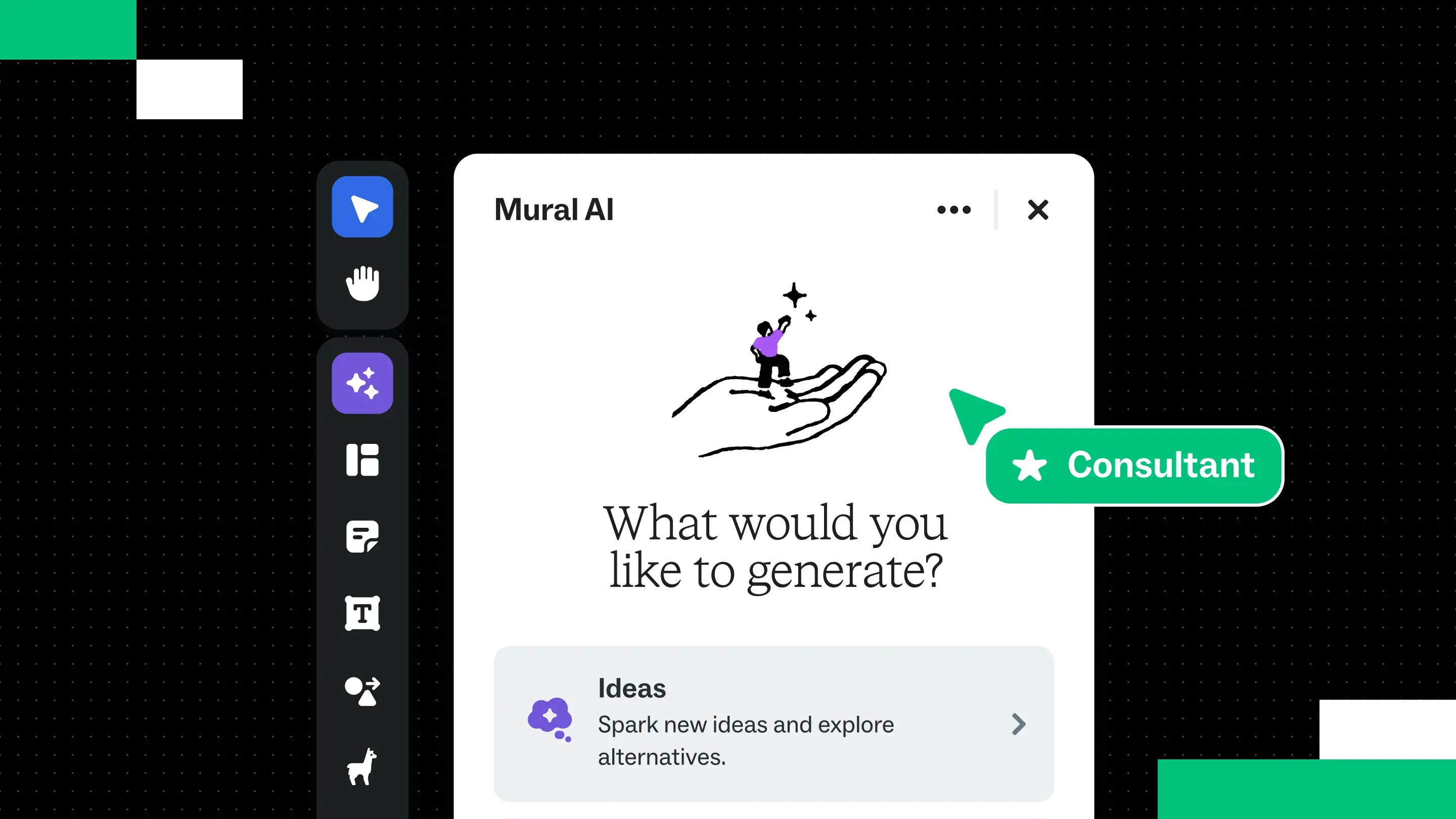
With Mural, teams can:
- Organize ideas and information: Capture customer insights, suggestions, questions, and opportunities on a shared canvas.
- Gather input from different roles: Invite stakeholders to contribute their perspectives during live sessions or asynchronously.
- Make contributions visible: Group related ideas to identify patterns, gaps, and areas of disagreement.
- Prioritize ideas and decisions: Use voting and structured activities to compare options and identify shared priorities.
- Capture next steps: Document decisions, responsibilities, and follow-up actions alongside the discussion that informed them.
- Create repeatable ways of working: Use templates to establish consistent approaches to planning, brainstorming, and team reviews.
For the onboarding project, participants could begin by adding insights from their respective departments to the canvas.
Next, they might organize feedback into recurring themes, such as unclear setup instructions, technical obstacles, or gaps in customer education.
Once the themes are visible, the team can evaluate possible improvements against shared criteria, including customer impact and implementation effort. Participants can use voting to surface priorities, then discuss any differences before agreeing on a direction.
The resulting canvas becomes a record of the ideas considered, the decisions made, and the actions that follow.
Rather than distributing disconnected notes after the session, the team can return to the same visual context as the project evolves.
Mural also offers templates for common collaborative workflows. The team charter template helps teams establish working agreements, while the broader Mural template library provides structured starting points for planning, brainstorming, and problem-solving.
Build stronger teamwork over time
Improving teamwork is an ongoing process. As projects evolve, responsibilities change and new people join, teams need to revisit their working practices and adapt them to new challenges.
Start by identifying where your team experiences the most friction.
If important updates are routinely missed, establish clearer communication expectations. If responsibilities overlap or projects lose direction, revisit goals and ownership. If employees spend too much time searching for answers, focus on knowledge sharing.
Choose one improvement and establish a practical way to evaluate its impact.
For example, a team struggling with unclear meeting outcomes might begin documenting decisions, owners, and deadlines at the end of each session. After several weeks, the team can assess whether follow-up actions are clearer and fewer decisions need to be revisited.
Regular reflection makes these improvements more sustainable. Use check-ins and retrospectives to ask:
- Does everyone understand our current priorities and responsibilities?
- Can team members access the information they need?
- Do people have opportunities to contribute and raise concerns?
- Are we following through on decisions and commitments?
- What should we change to work together more effectively?
Encourage honest feedback and make adjustments based on what the team learns.
Strong teamwork develops through consistent communication, shared accountability, and a willingness to improve how people work together. By strengthening these habits over time, teams can build better relationships, coordinate more effectively, and make steady progress toward shared outcomes.
Start improving teamwork today
Give your team a shared space to organize ideas, communicate clearly, and move work forward. Sign up for free to get started with Mural.