

.webp)
MCP servers use the Model Context Protocol (MCP) to help AI applications access tools, resources, and data across systems. By enabling AI interoperability between platforms, MCP servers support more connected, scalable, and informed AI experiences.
AI tools are everywhere now. Teams use AI assistants for planning, documentation, project coordination, research, collaboration, and automation. As organizations adopt more AI tools, those systems increasingly need to work together.
An AI assistant might summarize a meeting in one application, generate tasks in another, and surface supporting documentation somewhere else entirely. Every transition risks losing context, forcing teams to manually reconnect information between platforms.
The Model Context Protocol provides a standardized way for AI systems to connect to external applications, tools, and data sources. MCP servers act as the coordination layer that helps maintain continuity between these entities for a more cohesive and turnkey experience. The Mural MCP Server extends these capabilities to support connected AI-powered collaboration across systems.
What is an MCP server
An MCP server is a system that uses the Model Context Protocol to help AI applications coordinate activity across platforms, access other environments, and exchange information between tools.
MCP servers act as a bridge that allows AI applications to access external capabilities across systems without requiring custom integrations for every connection. They support connected AI experiences by making information and capabilities available across systems through a common interface.
For example, an AI assistant might retrieve information from a collaboration platform, coordinate updates with a project management system, and maintain cross-system awareness throughout the entire process.
What does MCP stand for
MCP stands for Model Context Protocol, which is an open-source standard for connecting AI applications to external systems.
The Model Context Protocol is a framework that enables AI applications to access tools, resources, and data from external systems through a standardized interface. It supports interoperability between AI tools by creating a standardized structure for sharing information between systems.
Why was the model context protocol created
The Model Context Protocol was created to standardize and simplify how AI applications connect to external tools and systems. Before MCP, developers often had to build and maintain custom integrations for every model, application, and data source combination. Teams often had to manually re-enter information, recreate institutional knowledge between systems, and coordinate disconnected activities across applications.
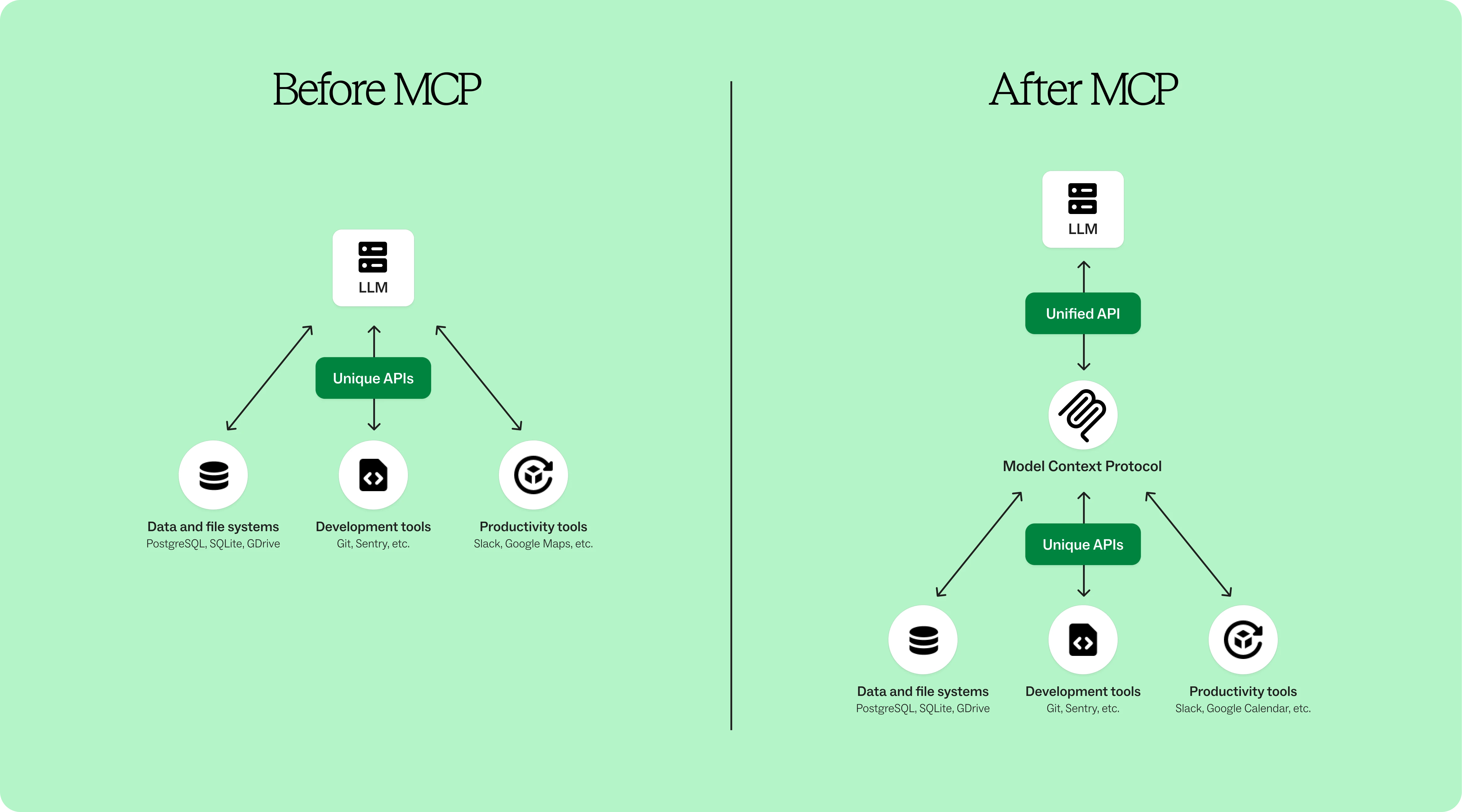
Introduced by Anthropic in November of 2024, MCP provides a standardized way for AI systems to expose tools, resources, and structured information. Instead of recreating connectors repeatedly, developers can build against a common interface that makes integrations easier to reuse across platforms.
What does an MCP server do
An MCP server exposes tools, resources, and structured information to AI applications through the Model Context Protocol. By providing a common interface between systems, MCP servers make it easier for AI applications to access external capabilities without requiring custom integrations for every connection.
Depending on the use case, MCP servers may help:
- coordinate information between systems
- support multi-tool AI processes
- reduce manual handoffs between teams
- improve continuity across platforms
- support connected AI experiences
MCP servers help AI-powered systems operate more cohesively across environments instead of behaving like isolated software interactions.
How are MCP servers different from APIs
MCP servers and APIs both help systems connect and exchange information, but they serve different purposes.
APIs provide a way for applications to access specific functions, services, or data through defined request-response interactions. MCP servers build on top of those underlying systems by providing a standardized way for AI applications to discover and access tools, resources, prompts, and data from external sources in a consistent way, so custom integrations aren’t necessary for every workflow.
MCP servers are not replacements for APIs. In many environments, MCP servers operate alongside APIs to support connected AI systems and shared operational awareness.
What is the difference between an MCP server and an MCP client
MCP clients and MCP servers play complementary roles within the Model Context Protocol.
An MCP server exposes tools, resources, prompts, or structured information to external systems. An MCP client consumes those capabilities and uses them to complete tasks on behalf of a user.
In simple terms, the client asks for information or actions, while the server makes those capabilities available.
For example, an AI assistant like Claude Desktop or Cursor may act as an MCP client. A GitHub integration, knowledge base, or collaboration platform exposing capabilities through MCP would act as an MCP server.
MCP clients and MCP servers are designed to work together. A client uses the Model Context Protocol to discover and interact with the tools and information made available by servers.
Together, they allow AI applications to connect with external systems without requiring custom integrations for every combination of models, tools, and data sources.
How MCP servers work
MCP servers help AI applications access shared tools, resources, and information across connected systems.
Rather than each AI tool working in isolation, the MCP server provides a common way for systems to exchange information and support more consistent workflows as data moves between platforms.
How MCP servers connect AI to other tools
MCP servers connect AI agents to other tools by acting as a coordination layer between these systems.
A typical interaction may look like this:
- An AI application initiates a request or activity.
- The MCP server provides access to tools and resources needed to complete the task.
- Connected systems exchange information across applications.
- Actions can be taken with that shared information and knowledge in other tools, or in the agent itself
This helps AI-enabled operations remain connected across systems instead of restarting at every handoff.
MCP servers connect AI agents with external systems, reducing the amount of manual coordination required between tools.
Without coordination, teams often experience:
- repetitive prompts
- duplicated effort
- disconnected information
- inconsistent AI outputs
- fragmented coordination
- siloed workstreams
MCP servers help reduce this friction and lead to effective coordination across connected environments.
Example MCP workflow
Imagine a product team planning a launch across multiple departments.
The team may use:
- a collaboration platform for brainstorming
- a documentation system for decisions
- a project management platform for execution
- AI assistants for summaries and coordination
An MCP server provides a standardized interface that allows those systems to exchange information more consistently.
Instead of manually recreating information in every application, teams can maintain consistency between tools while supporting more connected planning and execution processes.
For organizations coordinating complex initiatives, visual planning tools like Mural’s Product Roadmap Template can help teams align decisions, dependencies, and execution planning in one shared environment.
Why MCP servers matter for AI workflows
MCP servers are important because modern AI workflows increasingly span multiple systems, tools, and applications.
Organizations are no longer using a single AI assistant in isolation. They are building broader AI environments that include collaboration platforms, productivity systems, planning software, and operational tools.
As these environments grow more complex, coordination becomes more difficult.
MCP servers help support connected AI ecosystems by improving interoperability between tools to maximize efficiency and shared understanding.
Why AI to tool interoperability matters
Interoperability is important because disconnected systems create fragmentation across teams and processes, and lead to very inefficient systems of understanding and action.
As AI ecosystems expand, organizations face growing operational overhead caused by:
- manually transferring information between systems
- repeating prompts across applications
- recreating shared knowledge systems between platforms
- coordinating disconnected AI outputs
MCP servers help support interoperability by enabling systems to exchange information and preserve shared organizational context more consistently across applications.
Organizations exploring collaborative AI systems are increasingly focused on how shared context improves decision-making and team alignment. Mural’s collaborative intelligence insights explore this shift from isolated outputs to shared outcomes.
How MCP improves workflow consistency
MCP servers improve workflow consistency by giving AI agents a standardized way to access external tools and information.
This reduces the need to repeatedly re-establish information between tools, teams, and operational systems.
Improved consistency can help organizations:
- reduce manual coordination
- maintain shared operational state
- support connected AI experiences
- improve cross-platform collaboration
- scale multi-system AI processes more effectively
The goal is not simply automation. It is better coordination across connected AI systems, which leads to better outputs, and outcomes.
Why MCP adoption is accelerating
MCP adoption is increasing because organizations are rapidly adopting more AI tools across their operations.
As AI ecosystems become more distributed, organizations need better ways to coordinate systems, preserve institutional knowledge, and reduce fragmentation between platforms.
MCP servers help support:
- connected AI workflows
- shared organizational context
- AI tool interoperability
- operational coordination
This growing need for interoperability is driving increased interest in MCP infrastructure and orchestration layers.
Common Uses For MCP Servers
MCP servers are commonly used in environments that require sharing information between AI agents and other tools, data sources, and applications.
As organizations adopt more connected AI systems, interoperability use cases are expanding across collaboration, planning, operations, and execution management.
Connecting AI assistants across tools
MCP servers help AI assistants coordinate activities across multiple platforms.
For example, an assistant may retrieve information from a documentation platform while coordinating updates inside a project management system. That information could then be surfaced inside a visual planning environment for roadmap discussions and team alignment.
This helps support more connected AI experiences between systems.
Organizations managing complex planning initiatives often rely on shared visual workspaces like Visual Roadmap Alignment in Mural to coordinate priorities across teams and stakeholders.
Sharing information between applications
MCP servers help systems maintain continuity across information stored in different applications and tools.
This is useful in environments involving:
- collaboration platforms
- project management systems
- documentation environments
- operational dashboards
- internal knowledge systems
Instead of manually recreating information between tools, teams can maintain more connected processes across applications.
AI collaboration across teams
MCP servers support collaborative AI processes by making information and capabilities accessible across systems.
Teams increasingly use AI tools during:
- planning sessions
- roadmap coordination
- project reviews
- collaborative workshops
- operational planning
MCP servers help maintain continuity between those activities so teams remain aligned across systems and communication channels.
Organizations working across departments often benefit from stronger cross-functional collaboration practices that improve visibility and coordination between teams.
Multi-tool AI experiences
MCP servers support multi-tool AI implementations by helping systems exchange data across applications.
Most enterprise operations already involve multiple platforms. MCP servers help coordinate information between those systems so AI can operate more cohesively across environments.
This supports more scalable and connected AI experiences across organizations.
Teams coordinating distributed planning and execution processes often use shared digital workspaces like Mural’s visual collaboration platform to centralize planning, discussion, and coordination activities.
The growing role of MCP servers in connected AI ecosystems
MCP servers are becoming more important because AI systems are evolving from isolated assistants into connected operational participants.
Organizations increasingly want AI systems that can coordinate across applications to support continuity between tools, and ultimately lead to reaching better decisions more efficiently.
Connected AI workflows are evolving beyond standalone assistants and isolated productivity tools.
Organizations now use AI systems across:
- collaboration platforms
- documentation environments
- workflow automation systems
- project management tools
- operational planning environments
As coordination becomes more distributed, maintaining continuity between systems becomes increasingly important.
Disconnected systems create coordination problems.
Without the ability to connect data sources, AI agents, and workflows across teams and between applications, teams often experience:
- fragmented planning
- inconsistent outputs
- duplicated effort
- reduced visibility
- operational overhead
An MCP server exposes tools, resources, and structured information to AI applications through the Model Context Protocol.
Organizations managing large-scale planning and execution efforts often use frameworks like Mural’s organizational alignment resources to improve visibility across distributed teams and initiatives.
The future of interoperable AI infrastructure
Interoperable AI infrastructure is becoming increasingly important as organizations adopt more connected AI systems.
Organizations want systems that can:
- coordinate across applications
- maintain continuity between tools
- support continuity across platforms
- scale across distributed environments
MCP servers are emerging as part of the infrastructure layer supporting these connected AI ecosystems.
As AI-enabled operations become more connected across systems and teams, collaboration platforms face additional challenges around sharing information sources, coordination, and continuity. Explore this further in “Why AI Visual Collaboration Platforms Need MCP Servers.”
Explore the Mural MCP server
As organizations adopt more connected AI workflows, maintaining continuity across tools and applications becomes increasingly important.
The Mural MCP Server is designed to support connected AI-powered collaboration across systems.
Explore the key takeaways from our webinar in The end of solo AI: How Mural is building multiplayer intelligence for teams, including a look at Mural MCP and AI capabilities that help teams keep work connected from idea to execution.

%20(1).webp)
.jpg)


