

AI is “great for accelerating work, but it leaves open a really big need for alignment” - Olivia Hartle, Product Manager, Mural
In the "Meet the future of Mural AI" webinar, Elaina O'Mahoney joins Product Manager, Olivia Hartle, to explore the alignment gap that AI has created inside modern teams. Through a live product demo and a candid conversation about where enterprise AI adoption is falling short, they make the case for why the next chapter of AI at work isn't individual, it's multiplayer.
O'Mahoney and Hartle share the structural problem that solo AI tools have created for teams, the three pillars shaping Mural's AI product strategy, and a vision for collaboration where AI-generated work lands on a shared visual canvas rather than scattering across individual inboxes and private repos.
Why AI tools are making teams less aligned
"AI is only as powerful as the context that you give it," O'Mahoney says. "Otherwise, it's very blind to the solutions that it provides."
That same principle applies to teams.
AI tools increase individual productivity but reduce team alignment because every person works inside their own assistant, their own context, and their own outputs. When those outputs don't land in a shared space, teams arrive at their next meeting with different interpretations of the same work, and progress can stall.
The pattern is familiar. A team wraps up a planning session, everyone logs off, opens their own AI assistant, drafts their own notes, and sends individual follow-ups. By the next standup, it becomes apparent that everyone had a different understanding of where the project stood.
"This is not an AI problem," Hartle says. "It is a team workflow problem, and that's what we're trying to solve [here at Mural]."
Adopting AI hasn't delivered organizational ROI at scale because the tools were designed for individuals, not teams. Even when the first 60% of building something happens fast, the last 40% stalls because handoffs get disconnected and context doesn't transfer. Solo player AI tools have largely made people busier, not more aligned.
Mural’s three-pillar AI strategy
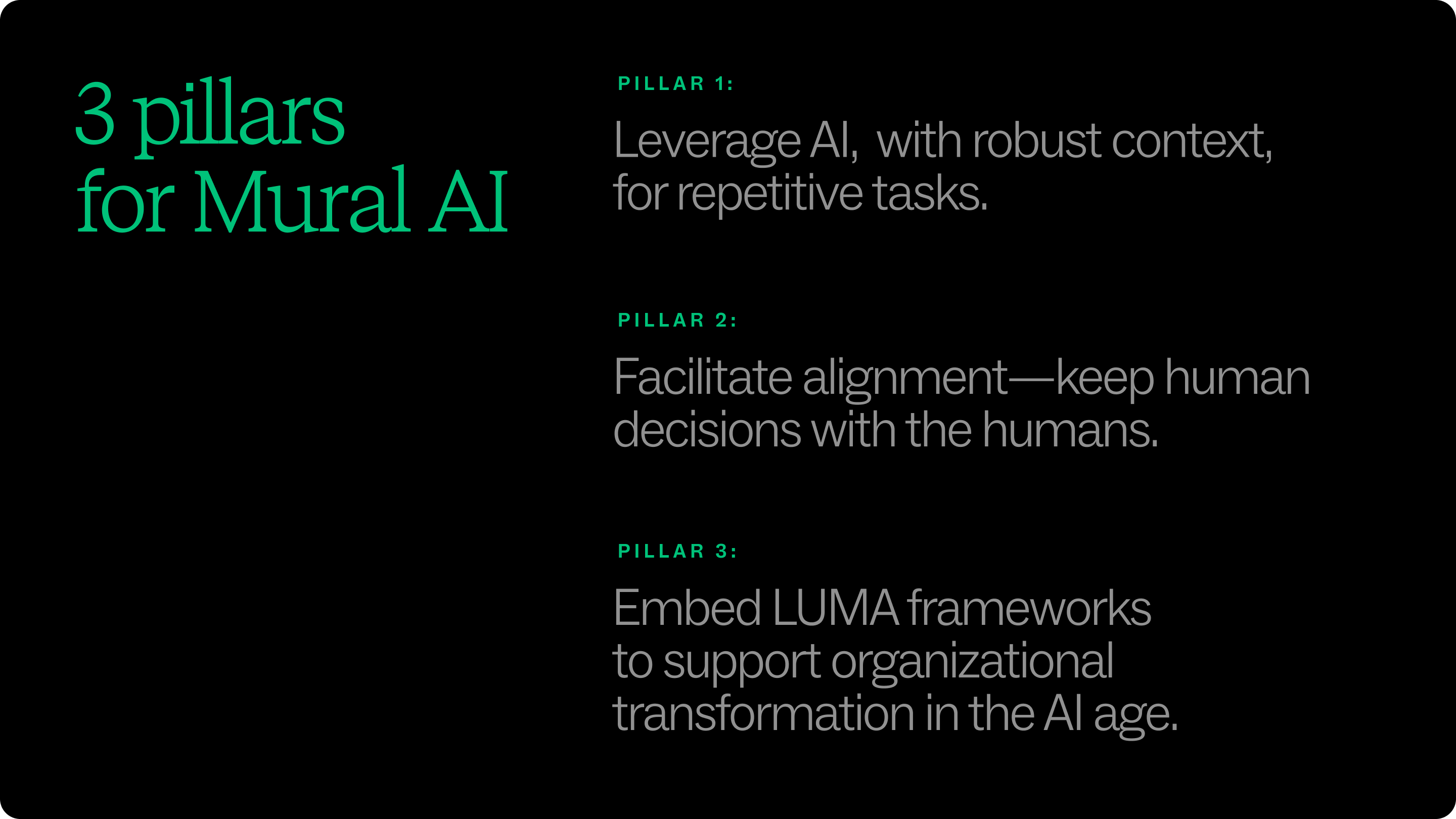
Mural's AI strategy is built around three pillars: automating routine busywork, driving continuous team alignment, and embedding proven facilitation frameworks directly into the canvas. Together, they close the gap between fast individual AI output and slow collective alignment.
Automate the work teams should no longer do
AI should be handling note-taking, transcription, synthesizing next steps, and updating systems of record. Not humans. "Nobody should be note-taking anymore," Elaina says. "Nobody should be synthesizing tasks or next steps. Nobody needs to be the stenographer in a meeting." The goal is to free people up for work that actually requires decision-making and collaboration.
Drive continuous alignment
Speed of individual output has outpaced the ability of teams to stay synchronized, and alignment can't remain a point-in-time event. Mural creates shared environments where AI-generated work surfaces visibly and contextually, open to collaboration rather than scattering across private chats and documents where no one can interrogate it together.
"Continuous alignment is really key," O'Mahoney states. "When everybody is doing that solo work, you're moving in the same direction together and having that ROI and business impact."
Embed proven frameworks directly into the canvas
Rather than expecting teams to know which facilitation method to apply, Mural embeds LUMA human-centered design frameworks like the Importance vs. Difficulty Matrix, retrospectives, and strategy reviews directly into AI-powered workflows. Teams gain structured starting points without needing a dedicated facilitator.
The goal isn't to eliminate individual AI work, but to ensure everyone doing that work is "moving in the same direction together."
What is “multiplayer AI”?
"The Mural canvas becomes the place where the team can come together to collaborate," Hartle says. "It's where multiplayer AI work lands visually and in minutes."
With Mural's Model Context Protocol (MCP) Server, a user's existing AI agent, already connected to their messages, documents, and project management tools, can synthesize all of that information and auto-populate a structured Mural template directly on the canvas. The entire team then jumps in to review, discuss, and refine together. No blank page, no manual synthesis, no alignment gap between what the individual's agent knew and what the rest of the team can see.
The three customer pain points MCP directly addresses:
- Disconnect in context. Teams running five to eight AI tools simultaneously end up drowning in disconnected outputs with no shared place to make sense of them.
- Gap in trust. When AI-generated work lands in a chat or document, there is no shared audit trail. A canvas changes that: work becomes visible, contextual, and open to challenge.
- Lack of facilitation structure. Teams want to run structured retrospectives and planning workshops but don't always have a dedicated facilitator or the right techniques.
What is Mural Compose?
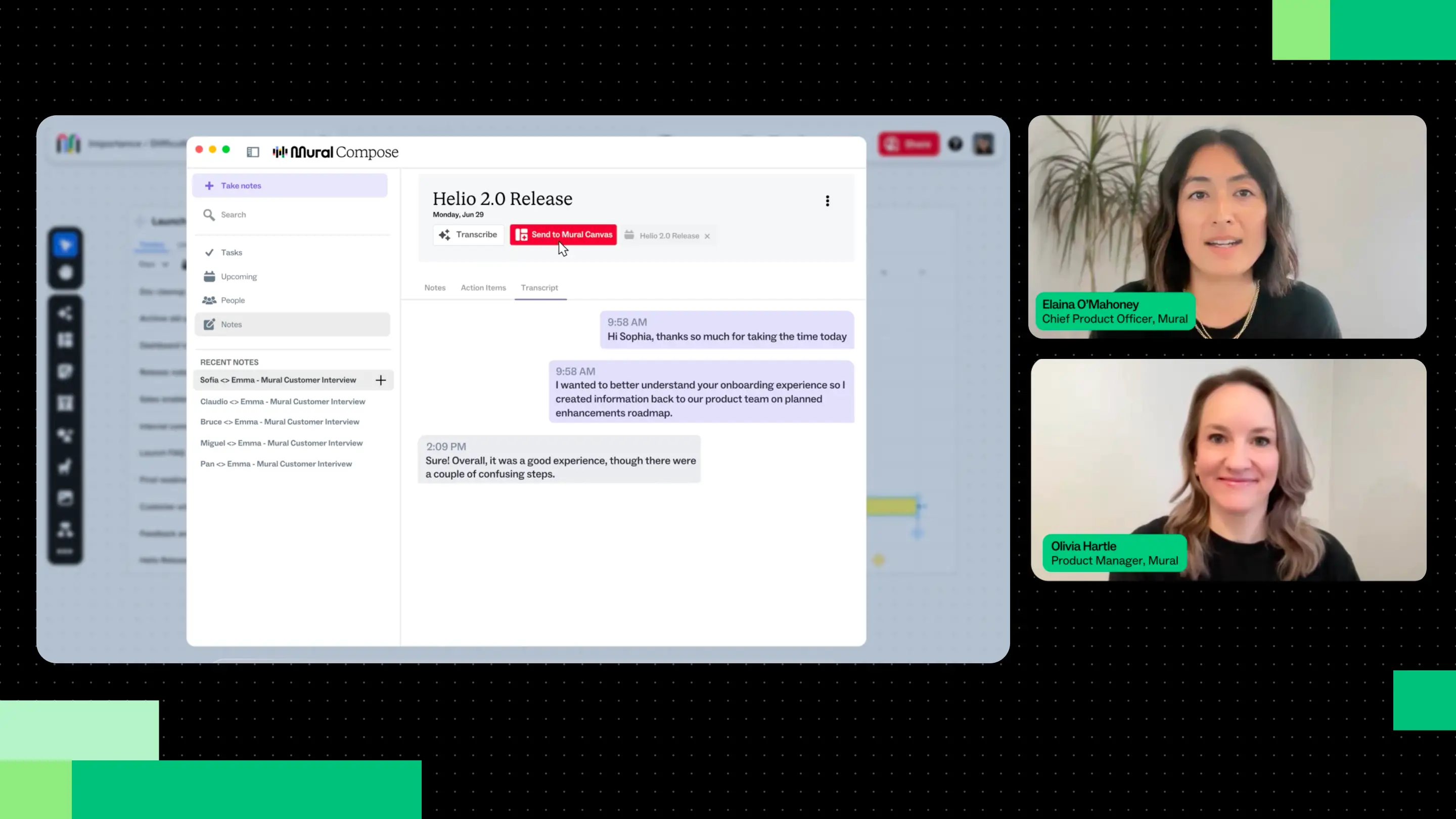
Mural Compose uses voice-to-visual capabilities that captures user interview recordings, generates transcriptions, summaries & action items, and maps the resulting insights visually onto the shared canvas alongside the product roadmap. It eliminates the manual work of coding transcripts and building affinity maps by hand.
The practical impact is significant. Instead of research findings living in documents no one reads, the entire cross-functional team (product, design, engineering, research, and product marketing) can see the full picture side by side and update the roadmap based on what users actually said, all without an additional synthesis meeting.
"Working this way condenses hours or even days of manual work into mere minutes," Hartle demos. "This new workflow frees up teams to move quickly, stay aligned, and focus on the strategic outcomes that matter most."
What remains uniquely human in an AI-powered workplace?
Strategic judgment, or what practitioners call "taste," remains uniquely human in an AI-powered workplace. AI can generate seven to ten ideas against a problem statement, synthesize context, and surface recommendations, but the decision about which idea to invest in, which direction serves the business, and which trade-offs are worth making still belongs to people.
"Deciding on the right idea to invest in, whether you are pitching a customer as a sales rep, whether you are building something in product, engineering or design, or whether you are deciding which channels to leverage in a launch campaign as a marketer, all of those decisions are rightly ours to make," Elaina says.
Beyond individual judgment, three human capabilities stand out as irreplaceable:
- Collective context. The real decision-making power isn't just what one person knows. It's the accumulated context of the group. Bringing diverse perspectives together to interrogate AI-generated work is what turns fast output into good decisions.
- High-trust interactions. Performance reviews, customer relationship-building, and team culture moments require human empathy and craft that AI cannot replicate.
- Shared learning. There is currently no L&D framework to teach AI proficiency in a specific role. The organizations navigating this era best are creating shared environments where colleagues learn from each other in real time, building multiplayer learning alongside multiplayer work.
"The way that we get the right thing to build and invest is with the context of the information and the collectivity power of the group," O'Mahoney explains. "It's about surfacing the information, looking at a lot of ideas, not just one, and then having that conversation and decision-making loop very, very quickly."
Ready to experience multiplayer AI?
The solo AI era is ending. Teams that create a shared visual canvas, where agents, researchers, product managers, and designers all contribute to the same living artifact, move faster, decide better, and build with more confidence.
Try Mural AI and see what it looks like when the entire team thinks together.

%20(1).webp)
%20(1).webp)


