

.avif)




.avif)

Your product team just wrapped a two-hour discovery session and you've got sticky notes full of amazing insights. The energy is atmospheric, and everyone agrees on the direction forward, but two weeks go by and engineering is building to a different spec than what UX researched. Then you discover your product manager is fielding questions from leadership about priorities that were supposedly settled.
This is a hypothetical, yes, but one based in reality. Studies show that 95% of new products fail to launch, costing companies millions in wasted time and investment. And the root cause isn't a lack of ideas or talent, it's a lack of shared visibility into the plan.
Your R&D team is under immense pressure to ship faster, respond to shifting customer needs, and coordinate across Product, UX, and Engineering, all while keeping leadership aligned on strategy. Yes, AI and hybrid delivery models are accelerating individual workflows, but if the team can't see the same roadmap, speed just compounds the misalignment.
A shared visual roadmap changes all of that. Once your research, priorities, and execution plans share one visible, connected space, R&D teams stop working from assumptions and start working from a common understanding.
What is a visual roadmap?
A visual roadmap is a way to represent plans, priorities, and timelines in a clear, visual format that teams can easily understand and collaborate on. Instead of scattering your strategy across static documents that lose relevance the minute they’re created, a visual roadmap keeps the plan visible and accessible to everyone involved in bringing it to life.
For R&D teams, this means Product, UX, and Engineering can all see what's being built, why it's being built, and how the work connects to customer needs and business goals. A visual roadmap isn't a static artifact. It's a living workspace that updates as priorities change, surfaces dependencies as they emerge, and keeps the "why" connected to the "what" throughout the product lifecycle.
Why Mural for visual roadmap planning?
R&D teams need shared visibility, cross-functional alignment, and faster planning. Most roadmap tools offer one of those things. Mural brings them together in a single visual workspace designed for the way R&D teams actually work.
- Shared visual workspace designed for alignment: Every function gets direct access to the plan and the reasoning behind it. Product managers own the strategic view, designers wireframe and prototype within the same canvas where requirements live, and engineering leads visualize system architecture using shapes and diagramming tools, including curated cloud architecture icon libraries from AWS, Azure, and Google Cloud, so technical decisions are visible to the full team, not buried in a separate tool.
- Real-time and async collaboration for distributed teams: Your canvas is the record of the conversation, not a summary written after the fact, so teammates in different time zones stay in the loop without chasing recaps. For scrum masters and R&D leaders running agile ceremonies, Mural's Facilitation Superpowers features keep sprint planning, retros, and PI planning sessions focused and productive.
- Visual planning for priorities, timelines, and dependencies: With nested areas (now available to all users), teams can organize complex murals into layered structures that make it easy to zoom into the detail of a sprint or zoom out to see the quarterly strategy. This flexibility means your roadmap can serve product leadership and individual contributors equally well.
- Built-in facilitation for structured planning sessions: Mural's Facilitation Superpowers® features give research and planning leads the ability to guide participants through structured activities, whether that's affinity mapping feedback from customer interviews, running a rose-thorn-bud exercise on prototype reactions, or using private mode so contributors share honest input without anchoring bias.
- AI-powered synthesis to move faster: Mural AI accelerates the messiest part of product planning: making sense of qualitative data. Summarize, Cluster, Generate, Classify, and Mind Maps keep your research, synthesis, and planning all in one connected flow. Learn more about Mural AI.
Examples of visual roadmaps for R&D teams
Visual roadmaps can take different shapes depending on your team's planning cadence and level of detail. Here are three of the most common formats R&D teams use in Mural.
Product roadmap visualization
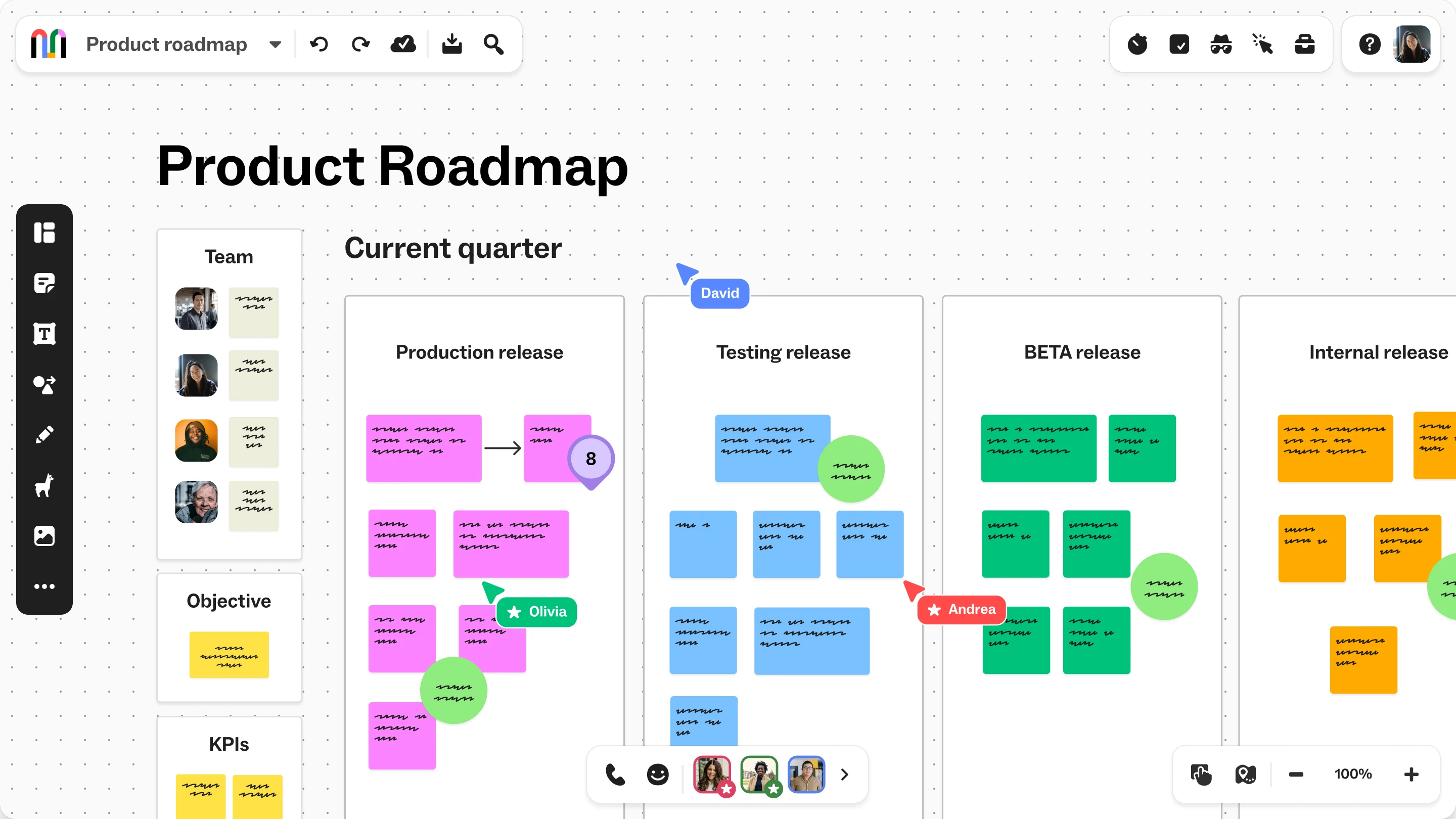
Visualize features, timelines, and priorities to align product, design, and engineering teams. Use Mural's product roadmap template to map initiatives, track progress, and communicate priorities clearly across teams. This is the format most R&D teams start with, especially when they need to connect customer discovery insights to what's actually being built.
Annual roadmap planning
Define long-term strategy and align teams around yearly goals and initiatives. Start with Mural's one-year roadmap template to map strategic priorities, timelines, and dependencies across the year. This works well for leadership alignment and for connecting quarterly execution back to annual objectives.
Quarterly roadmap planning
Break down long-term strategy into focused quarterly initiatives and align teams around near-term execution. Use a quarterly roadmap template to translate strategic goals into actionable plans and keep teams aligned on short-term priorities.
Teams can get started quickly with Mural's visual roadmap templates. They work as a starting point, a time-saver, and a standardization tool so your team isn't reinventing the format every planning cycle.
Benefits of visual roadmaps for R&D teams
When your roadmap is visible, shared, and connected to the work your team is doing every day, the downstream effects are significant.
Clear visibility across teams
Everyone sees priorities and timelines in one place. Engineers can see the customer quotes that shaped a requirement, product managers can trace a feature back to a specific pain point, and leadership can understand the evidence behind your team's priorities without a 30-minute walkthrough.
Stronger cross-functional alignment
Alignment between Product, UX, and Engineering isn't something you achieve once in a kickoff meeting. It's an ongoing practice that requires a shared space where priorities, dependencies, and progress are always visible. A visual roadmap gives every function a seat at the same table.
Faster planning and decision-making
Features like voting sessions, timers, and summon help you make decisions in the meeting, not after it. And with two-way sync with Jira and Azure DevOps, sticky notes from a planning session can become linked issues in your project management platform, and updates flow in both directions. Less back-and-forth, faster decisions.
Better communication of priorities
Instead of summarizing findings in a deck that people skim, you create a living artifact that everyone can reference, question, and build on. Visual clarity beats text-heavy docs when you need stakeholders, especially those outside the immediate R&D team, to understand and support your direction.
Common roadmap planning challenges and how to solve them with Mural
Roadmap planning is never as clean as the template suggests. Here are the obstacles R&D teams hit most often, and how Mural helps you move past them.
Lack of visibility across tools
Traditional roadmaps sit in slide decks and spreadsheets that go stale the moment they're shared. When discovery insights live in one place, planning happens in another, and execution is tracked somewhere else entirely, context gets lost at every transition. By the time a feature reaches development, the original customer insight that inspired it may be three degrees removed from anyone writing code.
Mural centralizes planning in a shared visual workspace. Your team can link discovery findings to product requirements to sprint tasks, all within one canvas. When a question comes up mid-development about why a feature was prioritized, the answer is visible on the canvas, not buried in an email thread from three months ago.
Misaligned priorities across teams
There's a finding from Atlassian that found people in organizations with poor collaboration cultures spend 50% more time in unnecessary meetings than they do making progress on important work. Oof. When teams interpret plans differently, you end up with duplicated effort across functions and decisions made in isolation without the full picture.
Visual roadmaps create shared understanding. In Mural, product managers can lay out the roadmap alongside the customer evidence that informed it, so every team is working from the same context, not their own interpretation of a text-heavy brief.
Difficulty keeping roadmaps updated
Most R&D teams don't lack a roadmap, they lack a living one. Customer feedback comes in after the roadmap is locked, then sprint priorities shift (but the strategic view doesn't update). And the people closest to the work, your engineers and designers, don't always have direct access to the rationale behind what they're building.
Mural enables real-time updates and async collaboration. The Content Library acts as a hub for approved designs, templates, and work plans, so R&D teams and go-to-market partners are always working from the latest information.
Slow alignment and decision-making
Too many meetings and too many handoffs. When discovery insights don't translate clearly to the rest of the R&D team, product decisions get made on incomplete information, and the back-and-forth to correct course eats into your timeline.
Teams collaborate visually in Mural and make decisions faster. R&D teams have the data acquisition part covered; what they struggle with is making sense of it quickly enough to act. Mural AI helps your team move from raw input to clear patterns in minutes instead of days.
The Summarize feature creates concise overviews of dense content on your canvas. Cluster automatically groups related sticky notes by theme. Classify sorts sticky notes by emotional sentiment. The common thread is that they keep your team working in the visual workspace rather than pulling data out into separate analysis tools.
Best practices for visual roadmap planning
A visual roadmap is only as useful as the habits your team builds around it. Here's how to get the most out of visual roadmap planning in Mural.
Start with clear goals and structure
Define outcomes first, then use templates to standardize planning. Mural's product roadmap template and one-year roadmap template give your team a shared starting point so you're not reinventing the format every cycle. You already know that great products start with a deep understanding of customer needs. Make sure that understanding is visible on the canvas before you start planning what to build.
Make priorities and dependencies visible
Process flowcharts and user story maps help teams visualize the path from requirements to release, making it easier to identify blockers and dependencies before they become delays. For teams managing multiple product lines, Mural's infinite canvas means you don't have to choose between the big picture and the details. You can have both, organized in a way that makes sense for your team.
Collaborate in real time and async
UX researchers can capture interview findings on sticky notes, map them against user journeys, and share the full picture with product managers and engineers, all in real time. When discovery insights are visual and accessible, the handoff to product planning becomes a conversation, not a translation exercise. And because everything is captured visually on the canvas, async participants can catch up on their own time without losing context.
Keep roadmaps flexible and up to date
The most dangerous moment in a product's lifecycle is the gap between "we've decided what to build" and "we're actually building it." That's where context drops, scope creeps, and that important original customer insight that drove the decision starts to fade from view. A visual roadmap in Mural closes that gap by keeping the strategic rationale connected to execution at every stage. The two-way sync with Jira and Azure DevOps means the strategic view in Mural and the execution backlog stay connected, so your roadmap is always a living document, not a snapshot from last quarter.
Get started with visual roadmaps in Mural
R&D teams don't fail because they lack good ideas, they fail because those ideas lose clarity and momentum as they move through discovery, planning, and execution. A shared visual roadmap gives your team a single, connected space to see the strategy, the evidence behind it, and the path to launch, all in one place.
- Start quickly with pre-built roadmap templates: product roadmap, one-year roadmap, and quarterly roadmap
- Collaborate with your team in real time or async
- Build, iterate, and share visual roadmaps in one place
With Mural, Product, UX, and Engineering can gather customer intelligence, synthesize insights with AI, and build a roadmap that stays aligned from brainstorm to launch. Explore the product roadmap template to see how your team can get started, or book a demo to see how Mural works for R&D teams at your scale.
%20(1).webp)
.webp)
.webp)




%20(1).webp)