The biggest difference, I think, is going to be who has the best organizational context to point AI at.” — Daniel Su, Product Leader, Mural
AI has made individuals dramatically faster. But that doesn’t mean their teams are moving faster with them.
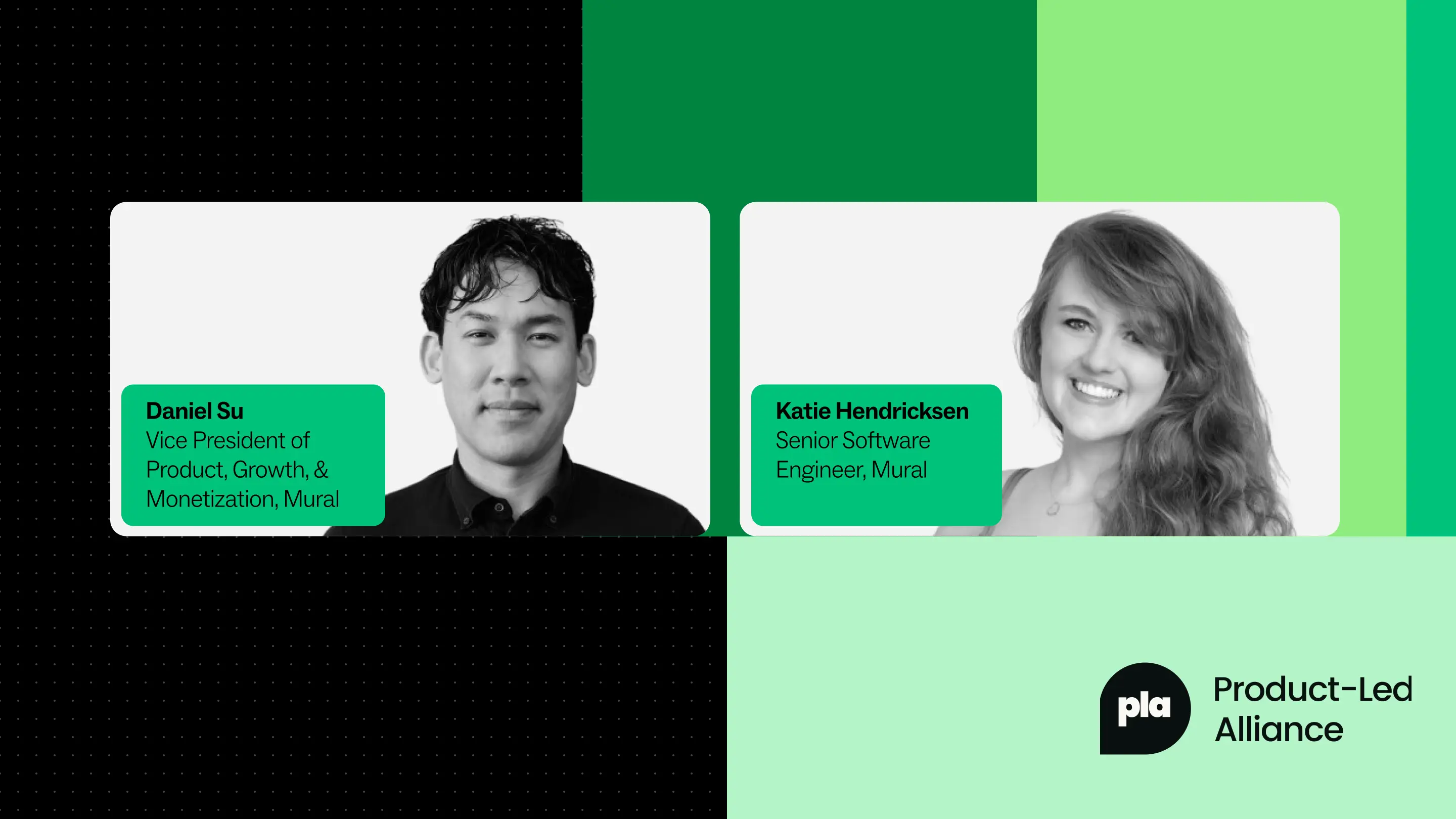
In the recent webinar “The End of Knowledge Silos”, Product Leader Daniel Su and Software Engineer Katie Hendricksen explore why AI’s next bottleneck isn’t generation. It’s context. As teams create more code, documents, research, and decisions with AI, the information needed to make sense of that work is increasingly scattered across tools, conversations, and people.
Their argument is that the organizations that get the most from AI will be the ones that turn fragmented individual knowledge into connected context that people and agents can use together.
AI makes teams reach the collaboration bottleneck faster
AI has compressed the time it takes to produce work. Katie sees projects that might once have taken a month getting done in a week. But all the collaboration around that work still needs to happen.
“I feel like we're hitting these collaboration point so much faster than we would have previously,” Katie says.
That creates a new kind of bottleneck. Product, engineering, design, research, marketing, and customer teams can all generate more, but their work still depends on context from one another.
Katie describes what should have been a simple engineering change that required reconstructing a web of information across a product requirements document, Figma designs, existing code, a Slack thread, an experiment, and support tickets.
“Before you write a single line of code, you need to kind of do this archaeology across all these different tools to understand what is even the current state of things.”
AI encounters the same problem. A coding agent can understand the code without knowing the customer conversation, product decision, or technical tradeoff that explains why it exists.
“The AI can understand the code, but it doesn't understand all those extra little pieces of context you need to actually do the job well,” Katie says.
The faster teams generate, the more consequential those missing pieces become.
Connected intelligence turns individual context into team context
Daniel describes the next stage of AI adoption as connected intelligence: taking the AI activity happening among individuals and turning it into a shared intelligence layer that the whole team can access.
“Connected intelligence, I think, is a word we can put to this idea where we take all the scattered individual AI activity that everyone's doing,” Daniel says, “and basically turn it into this shared intelligence layer that hopefully the whole team and maybe the whole company can access.”
Today, one person’s agent might research a problem, draft a document, or analyze data. But that context often stays inside that person’s workflow. Connected intelligence makes it available to the rest of the team and their agents.
The goal isn’t simply to connect everything.
As Daniel clarifies, “It's not necessarily [that] the more context is built is better. It's [that] the right context is important.”
Katie compares working with an agent to onboarding a new employee. You wouldn’t give someone every document the company has ever created. You’d give them the information relevant to the job in front of them.
That means context needs to be curated, current, and traceable.
“If you dump everything into the context window, the really important information ends up drowning, and the model starts paying attention to things that don't necessarily matter, or anchors on something that's stale,” Katie says.
Context, then, becomes an organizational responsibility, not simply an engineering challenge. Product decisions, customer insights, designs, metrics, transcripts, and implementation history all contribute to the picture an agent needs to do useful work.
Human judgment keeps AI pointed at the right outcome
More capable agents don’t eliminate the need for human judgment. They make it more important.
AI output can look polished and convincing even when the context behind it is incomplete. Katie has seen agents create pull requests in the wrong repositories because they weren’t given the right information. When an agent explains why a piece of logic exists, she wants to know where that explanation came from.
“If AI just tells me this logic exists to handle a race condition, my next question is gonna be ‘okay, well, how do you know that?’”
That traceability gives people something they can inspect rather than asking them to trust an answer because it sounds right.
The same principle applies at the team level. Daniel points to shared definitions of metrics as an example. If teams define “active user” differently, AI can generate different analyses from the same underlying work. Those analyses feed documents, proposals, and eventually decisions.
Speed can compound good context. It can compound bad context just as quickly.
That’s why Katie emphasizes the difference between producing more and accomplishing more. “You really have to focus on the outcomes, not just your output.”
Three ways to build better context for people and agents
Daniel distills the discussion into three practices teams can apply now:
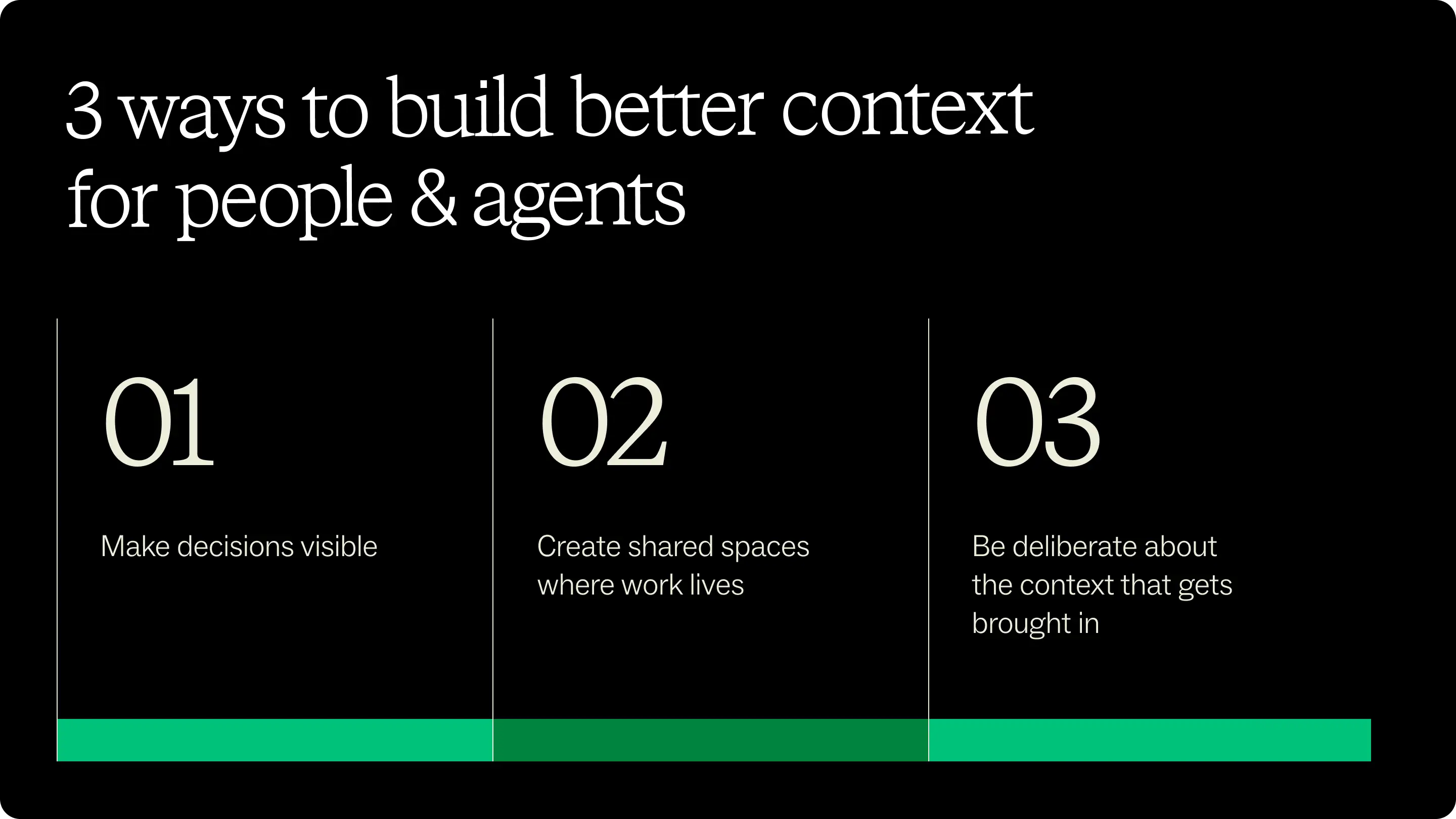
- Make decisions visible
- Create shared spaces where work lives
- Be deliberate about the context that gets brought in
“The theme across all of this really is how information flows out of people, between people, and not just how your tools integrate,” he says.
Make decisions and reasoning visible
A decision made in a direct message, hallway conversation, or meeting and never documented becomes invisible to everyone who wasn’t there, including AI.
Teams should capture the decision and the reasoning behind it.
Daniel describes this as “making sure that we have the ‘why’ with the ‘what’.”
For product teams, that means documenting not only what was prioritized, cut, or changed, but the tradeoffs that drove the choice. As Daniel explains, “we should capture both the decisions and the trade-off that drives it together, and attach it to whatever work we're sending out, like the artifact.”
The next teammate or agent can then understand the path the team took instead of reconstructing it from scratch.
Give shared work a clear place to live
Different kinds of work will continue to happen in different tools. The problem is having no clear place where the current context surrounding an initiative comes together.
“The failure mode, to me, isn't too few docs,” Daniel says. “It's basically 20 half-current ones in different places.”
His recommendation is straightforward: Pick one place where an initiative or project lives, then bring the relevant context together there.
Mural’s MCP Server extends that idea to agents. MCP-compatible agents can read and write directly to a Mural canvas. When an agent is connected to sources such as Slack, Jira, Linear, or Google Drive, MCP can bring relevant context into the shared visual workspace rather than requiring someone to manually rebuild it.
Design for the handoff
Shared context is most useful when the next person knows what happened, why it happened, and what to do next.
For Daniel, that makes the handoff itself an outcome.
“The most important piece is the handoff, right?” he says.
As AI shortens the time between stages of work, that becomes even more important. A faster first draft doesn’t save much time if the next person has to spend hours reconstructing its context.
The AI advantage may become a context advantage
Models will continue to improve, and access to capable AI will become increasingly widespread. Daniel argues that this changes where organizations can create an advantage.
“My belief is that the edge over the next few years really won't come for who has the most AI, who's paying the most for AI,” he says. “Because everyone will have access to all the same models pretty soon. The biggest difference, I think, is going to be who has the best organizational context to point AI at.”
And “best” doesn’t mean accumulating the most information. It means making context connected and organized enough that people and agents can find the right signals and use them. Daniel argues that companies building that foundation will be better positioned to move quickly while staying aligned.
There isn’t a settled playbook for doing that yet, which Katie sees as an opportunity.
“If you have an idea for a new way to capture context, or a new way for your team to work with agents, or maybe a process to kill or invent, you don't need to wait for a playbook or ask for an admission, because nobody really knows the right way yet,” she says.
AI has made experimentation cheaper and production faster. The next challenge is making sure all that speed adds up to collective progress.
The teams that solve that problem won’t simply generate more. They’ll build the shared context that lets humans and agents move forward together.
Try Mural AI and give your team the shared context to move from AI speed to collective progress.