

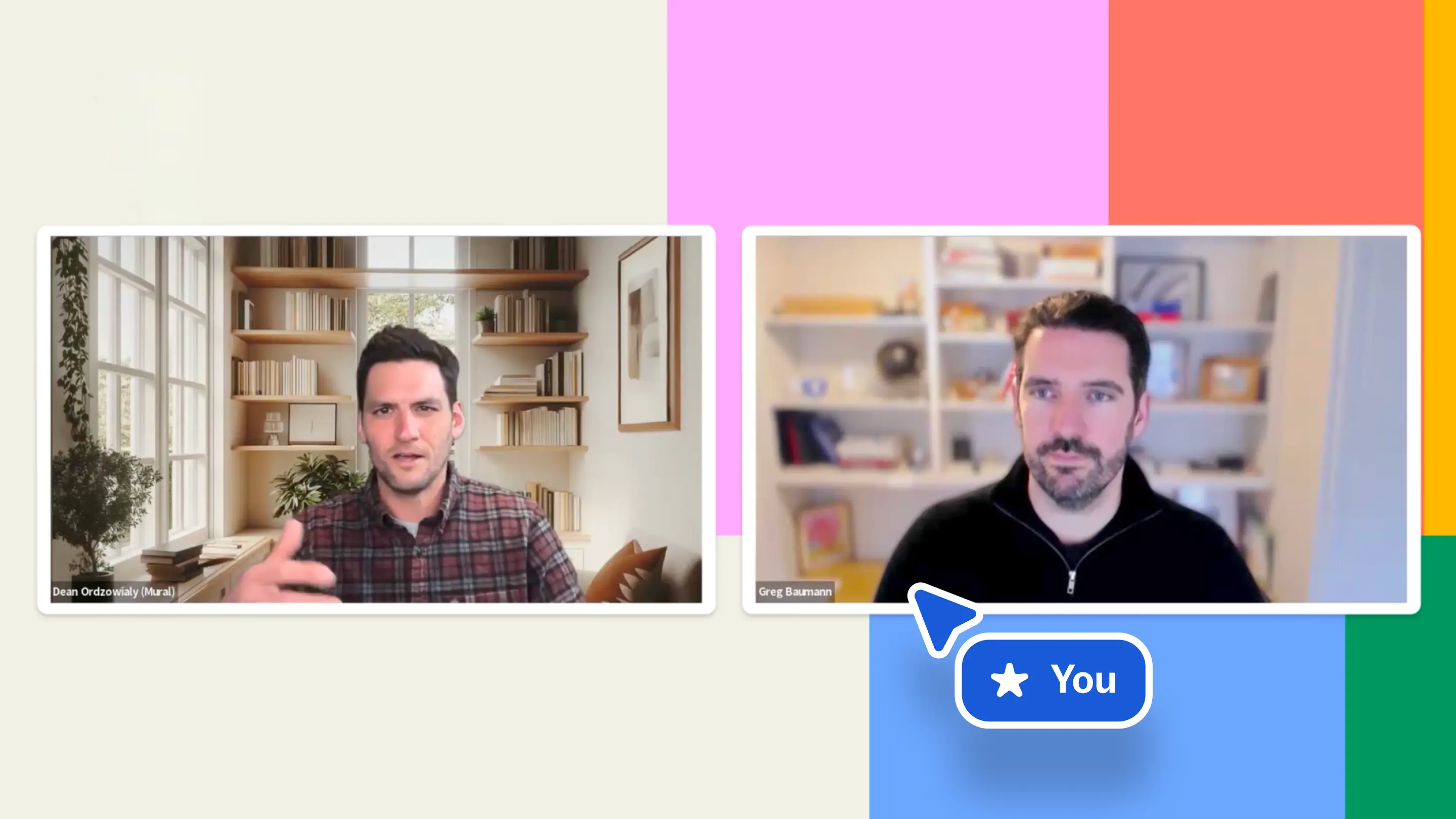
"The one thing that's constant when things go well is that we have multiple business sponsors across the organization, and that we have really good relationships with those people." — Dean Ordzowialy
In this webinar, Dean Ordzowialy, Associate Vice President of Account Management at Mural, and Greg Baumann, Senior Director of Sales at Outreach, sit down for a candid sales-leader-to-sales-leader conversation. The discussion covers the dynamics reshaping enterprise selling today: how AI has changed the way teams prepare, why in-person moments matter more than ever, and what it actually takes to build the relationships that determine whether a deal moves forward or stalls.
We want to highlight a central thread running through the conversation, which is the concept of the business sponsor. Not the economic buyer, not the champion in the traditional sense, but the person inside a customer organization who understands the full scope of the partnership and carries that case into rooms the seller never enters.
The new shape of enterprise selling
Enterprise selling has always been about relationships; what’s changed is how those relationships get built, and how much ground a seller has to cover before walking into a room.
Both Dean and Greg point to a meaningful shift in how teams prepare for in-person meetings. Sellers who used to walk down the hall and get around a whiteboard together are now running distributed prep sessions that draw on AI research agents, account plan data, and collaborative tools before anyone gets on a plane. As Greg puts it, it’s a multi-channel internal experience designed to deliver something seamless externally.
"I find that probably 90% of my team's prep is virtual," Greg says. That prep draws on everything the team knows about the account: context from AI research agents, a shared view of what success looks like for the on-site, and alignment on what they need to learn. "What are we hearing? What do we know? What is the research that we're learning from our AI agents? What is the mission? What makes this on-site meeting a success for us?"
At the same time, in-person is fully back. Customers are in the office. Prospects are open to it. The value of being together is no longer something that needs to be argued for. The difference now is that the work required to make those in-person moments count is more intentional than it was before.
Dean sees AI shaping the seller's day at every level, from account plan development to daily communication, and notes that work that used to take hours can now take minutes when the right data is in hand. The opportunity is real. So is the risk of becoming too dependent on the tools and losing the underlying drive to get in front of people, ask hard questions, and earn the relationship.
The business sponsor: the relationship that holds everything together
Don’t confuse the economic buyer with the business sponsor
One of the most useful distinctions Dean draws is between the economic buyer and the business sponsor. They’re not the same person, and treating them as interchangeable is one of the more common ways deals go sideways.
The economic buyer holds the budget and makes the final call. The business sponsor is the person who understands the value of the partnership from the inside, bridges the gap between day-to-day users and senior decision makers, and advocates for the product in leadership conversations where the account team is not present.
"Without them in that gap," Dean explains, "you don't typically see decision makers or economic buyers talking to the users. It's somebody in between. And are they willing to go to bat for you? Are they gathering the feedback? Are they acting as that healthy buffer and really influencing the overall partnership?"
Greg connects this to the concept of selling through the room you are in. When a business sponsor leaves a meeting, they carry the conversation back to their organization. The seller's job is to make sure that person is equipped to represent the problem, the opportunity, and the solution clearly enough to move things forward when the seller is not there.
How to find your business sponsor
Dean describes business sponsor identification as a combination of what the team already knows and deliberate outreach into new contacts. Title matters: director and VP and above are the range where this profile typically lives. But it is not purely a targeting exercise.
Discovery is the mechanism. Dean's frame is that 90 to 95 percent of a sales conversation should be about the customer, their business, their priorities, and the outcomes they are trying to drive. If a seller is doing that well, the business sponsor tends to surface. The pain becomes clear, and the customer starts asking questions back.
"In discovery, like 90 to 95% of the conversation is all about the customer and their business," Dean says. "And then you ask enough questions, and you get to the pain enough, and all of a sudden, now they're asking you questions."
Greg frames the same instinct as doggedness, one of three qualities he actively screens for when hiring. The willingness to go find the information, to get in front of people, to not stay comfortable with what you already know.
Going wide: why one relationship is never enough
Both Dean and Greg are emphatic that single-threaded deals are fragile deals. The pressure to go wide within an account is not just a coverage strategy. It reflects how enterprise buying actually works.
Buying committees keep getting larger. Which means selling committees need to keep pace. Greg describes large global accounts where there might be 200 VPs worth reaching, not five. His enterprise account executives carry a metric of 200 prospects contacted per month, supported by AI agents and data quality pipelines, but owned by the rep.
To illustrate the risk of single-threaded selling, Greg uses an analogy: imagine a group of people standing around an elephant with their eyes covered. Each person is touching a different part of the animal and forming a completely different picture of what it is. A seller who only talks to one stakeholder is only seeing one part of the animal. The account is still the same elephant.
"We need to be finding all of those people who are standing around the elephant," Greg says, "but we also need to make sure that they're seeing the part that they need to see." The value proposition for a sales operations leader looks different from the value proposition for an individual contributor or a sales leader looking at their business holistically. Multi-threading means staying attuned to each of those vantage points.
Executive alignment: doing it early, doing it deliberately
Executive alignment comes up late in the conversation but carries significant weight. Both Dean and Greg treat it as a deal driver, not a deal rescue move.
Dean's approach at Mural is title-to-title connection: CRO to CRO, CMO to CMO. The team uses a dedicated Slack channel to route exec alignment requests. When an account growth plan surfaces a gap at the leadership level, that is the trigger to bring in the right executive counterpart, and to do it earlier in the cycle rather than waiting until the deal is at risk.
"I've seen accounts that have great adoption. Users say everything is great. But then if you're not at the right levels, you're not connected at the right levels, that can fall flat," Dean says. "So I think of it as high and wide in organizations, with the right people. And along the way, that's going to uncover any potential risk, so you can get ahead of those conversations."
Greg echoes this with a point about risk visibility. The deals that get away are often the ones where everything looked fine in the one-on-one. The good news gets reported; the risk stays buried. Deal health scoring at Outreach has helped his team surface those signals and then respond with targeted executive outreach. By his account, having executives engaged in deals has contributed to win rate improvements of roughly 15 to 20 percent over the past year.
Greg describes what that looks like in practice: when a red alert indicator surfaces in an opportunity, his team pulls up the full account plan, identifies where alignment is missing, and responds with targeted executive outreach. "Their CRO is in Texas, our CRO is in Texas — let's draft something from our CRO that'll be a valuable way for her to connect with their CRO." That, he says, is visual, collaborative selling.
How Mural uses Mural
One of the more grounding moments in this chat is Dean describing how Mural's own account management team approaches this work inside Mural. Account growth plans live in murals. Stakeholder maps show who in the organization is known, who is not, and where the gaps are. When the team sits down to review an account together, everyone's cursor is visible and the work of filling in the unknowns is collaborative.
"When we plop into a mural and we're looking at the account growth plan, you can see everybody's cursors going around," Dean says. "We're brainstorming, we're putting in action items, we're tackling things together. There's so much we don't know, but there's a lot we know. And the don't know kind of scares us, but also excites us."
That framing, that uncertainty is something to go execute against rather than something to avoid, runs through this entire conversation and is definitely worth a watch. The deals and partnerships that go well are the ones where teams are honest about what they do not know and go find it, together.
Want to see the full conversation? Watch the webinar here.


