

.webp)
Strategic team building activities for the workplace
Team building activities are structured exercises that help coworkers strengthen connection, communication, trust, and collaboration. Effective team building gives people a low-stakes way to learn how their teammates communicate, solve problems, contribute ideas, and work with others.
That can help new teams get acquainted, established teams strengthen working relationships, and cross-functional groups coordinate across roles. The goal is to intentionally step out of everyday tasks and do an activity together, to make working together easier when the team returns to real projects, decisions, and deadlines.
Below are team building activities for work organized around three goals: building connection, improving communication, and practicing collaboration. You'll also learn how to choose an activity that fits your team.
Why team building matters at work
Team building activities are important because effective teamwork depends on more than individual skill. People also need to understand how their coworkers communicate, contribute, and approach problems.
Workplace team building activities can support:
- Stronger communication: Teams practice explaining ideas, listening, asking questions, and interpreting information.
- Greater trust and connection: Learning more about coworkers can make it easier to ask for help, contribute openly, and give feedback.
- Better participation: Structured exercises give more people defined opportunities to contribute.
- More effective problem-solving: Activities expose teams to different approaches and perspectives.
- Stronger working relationships: People gain context about teammates they may not work with regularly.
Team building is one part of creating an environment where people can work well together.
Team building ideas for the workplace
The best team building activities for work depend on what the team needs.
A newly formed group may need opportunities to connect. A team struggling with misunderstandings may benefit from communication exercises. A cross-functional group may get more value from an activity that requires people to coordinate around dependencies.
The activities below can be adapted for in-person, remote, or hybrid teams where noted. For more quick ways to get distributed groups talking, explore these icebreakers for virtual meetings.
Activities for building connection
Connection-focused activities help teammates learn about one another beyond their job titles. They're useful during onboarding, team kickoffs, reorganizations, or whenever people need more opportunities to interact outside normal workflows.
Name and connection game
Time: 15 minutes
Group size: Up to 20 people
Best for: New teams, onboarding, and groups that don't know one another well
How it works: Have everyone form a circle and say their name. One person tosses a ball to another participant after saying that person's name. Continue passing it around while adding rules, such as not sending it to the same person twice.
For a remote version, teammates can verbally "pass" the ball. Add rules that encourage people to connect outside familiar groups.
Reflect: What did you have to pay attention to as more rules were added?
Group map
Time: 20–30 minutes
Group size: Up to 20 people
Best for: Distributed, international, remote, or newly formed teams
How it works: Start with a shared map and ask each person to mark a place that has shaped who they are. It might be a hometown, a country they've lived in, or another meaningful location. Invite each person to share something they learned there.
Remote and hybrid teams can use Mural's World Map template so everyone can add their location and story in the same shared space.
Reflect: What did you learn that expanded how you understand someone on the team?
Achievement sharing
Time: 30 minutes
Group size: Up to 20 people, divided into groups of five or fewer
Best for: Building deeper connection and understanding teammates' strengths
How it works: Divide participants into small groups and ask each person to share an achievement they're proud of. It can be professional or personal.
Encourage people to explain why it mattered. The stories can reveal skills, motivations, and values that aren't obvious from someone's role.
Teams can also use Mural's Welcoming Get-Together template to collect and share introductions and achievements.
Reflect: What strength or value did you notice in a teammate that you hadn't seen before?
Activities for improving communication
Communication exercises give teams a safe setting to practice explaining ideas, listening carefully, and adjusting in real time.
Blind drawing
Time: 10–15 minutes
Group size: Pairs
Best for: Clear explanations and active listening
How it works: Pair participants and give one person an image their partner can't see. The person with the image describes it without naming exactly what it is, while their partner tries to recreate it.
For remote teams, send the reference image privately to the person describing it and have their partner draw on paper or in a digital workspace.
The exercise makes the gap between intended and received communication easy to see.
Reflect: Which instructions made the task easier, and when did you need more context?
Count to 20
Time: 10 minutes
Group size: 20–50 people
Best for: Listening, group awareness, and coordination
How it works: The team's goal is to count from 1 to 20, with 1 person saying each number. There's no predetermined order. If 2 people speak at the same time, the group starts over.
The activity works in person or on a video call and requires no materials.
Reflect: How did the group change its approach after having to restart?
Jenga questions
Time: 20–30 minutes
Group size: Groups of up to eight
Best for: Informal communication and getting teammates talking
How it works: Write a question on each piece of a Jenga set. Whenever someone removes a piece, they answer the question before placing the block on top.
Prompts can be personal or work-related. Keep them appropriate and let people skip anything they don't want to answer.
For remote teams, a facilitator can manage the physical game while participants choose pieces.
Reflect: What answer gave you a useful new perspective on how someone else works?
Activities for practicing collaboration
Collaboration requires more than exchanging information. Teams also need to coordinate decisions, share resources, and manage dependencies.
Scavenger hunt
Time: 15–20 minutes
Group size: Any
Best for: New teams, workplace orientation, and cross-team interaction
How it works: Give teams a list of objects, facts, or clues to find within a set amount of time. An office-based hunt might send participants to different areas or departments. A remote version can ask people to find household items, photos, or information.
For a workplace-focused variation, include clues that require information from other functions.
Reflect: When did another person's knowledge or perspective help your group move forward?
Team jigsaw puzzle
Time: 20 minutes
Group size: Teams of two to four
Best for: Dependencies, negotiation, and cross-team coordination
How it works: Give each group a different jigsaw puzzle, but swap several pieces between puzzles before the activity starts.
Teams will eventually realize they can't finish without coordinating with other groups to exchange pieces.
The exercise mirrors a common workplace dynamic: one team can execute well and still depend on another to reach the final outcome.
Reflect: How did your approach change once you realized success depended on another team?
How team building supports cross-functional collaboration
Team building can be especially useful for cross-functional teams because people from different departments bring different priorities, terminology, responsibilities, and assumptions to the same work.
Activities that expose those differences in a low-stakes environment give teammates a chance to understand one another before complex projects put those relationships under pressure.
The team jigsaw puzzle makes interdependence visible. A achievement-sharing exercise can surface experiences and strengths that aren't apparent from job titles. A scavenger hunt can highlight knowledge from multiple departments.
For cross-functional teams, effective activities can help people:
- Understand what different roles and functions contribute
- Exchange perspectives before making decisions
- Communicate across departmental boundaries
- Identify dependencies earlier
- Connect each function's work to a shared outcome
Team building doesn't replace the operating practices cross-functional work requires. Teams still need shared goals, clear responsibilities, communication norms, and ways to coordinate dependencies.
Teams that want to clarify purpose, roles, values, and expectations can also use Mural's Team canvas template.
What makes a team building activity effective?
An effective team building activity starts with a clear purpose. Choose the exercise based on what the team needs rather than which game sounds most entertaining.
Consider:
- Purpose: Are you trying to build connection, improve communication, or practice collaboration?
- Team goal: What real working relationship or behavior do you want to strengthen?
- Group size: Will people participate more effectively as a full group, in small groups, or in pairs?
- Available time: Leave enough time for instructions, the exercise, and reflection.
- Participation preferences: Give people different ways to contribute when possible.
- Accessibility needs: Consider physical, sensory, cognitive, location, and technology requirements.
- Simple instructions: Participants should spend their time doing the activity, not deciphering rules.
- Reflection: Ask what the group noticed and how it applies to everyday work.
Reflection can make a team building exercise more useful by connecting it to real working habits. Ask: What made this easier or harder? What did we learn about how we communicate? Where did we depend on someone else?
The right activity will vary by team, so ask participants what worked and what they'd find useful in the future.
Create a stronger foundation for teamwork with Mural
The value of team building shouldn't disappear when the activity ends. Capturing what people contributed and learned gives teams something they can return to in future projects, planning sessions, and retrospectives.
A shared Mural canvas gives facilitators a place to organize prompts, gather input from different roles, make contributions visible, and capture reflections.
Browse the Mural template library for structured ways to run collaborative sessions, or try the Team Building Playground template for activities designed around connection and teamwork.
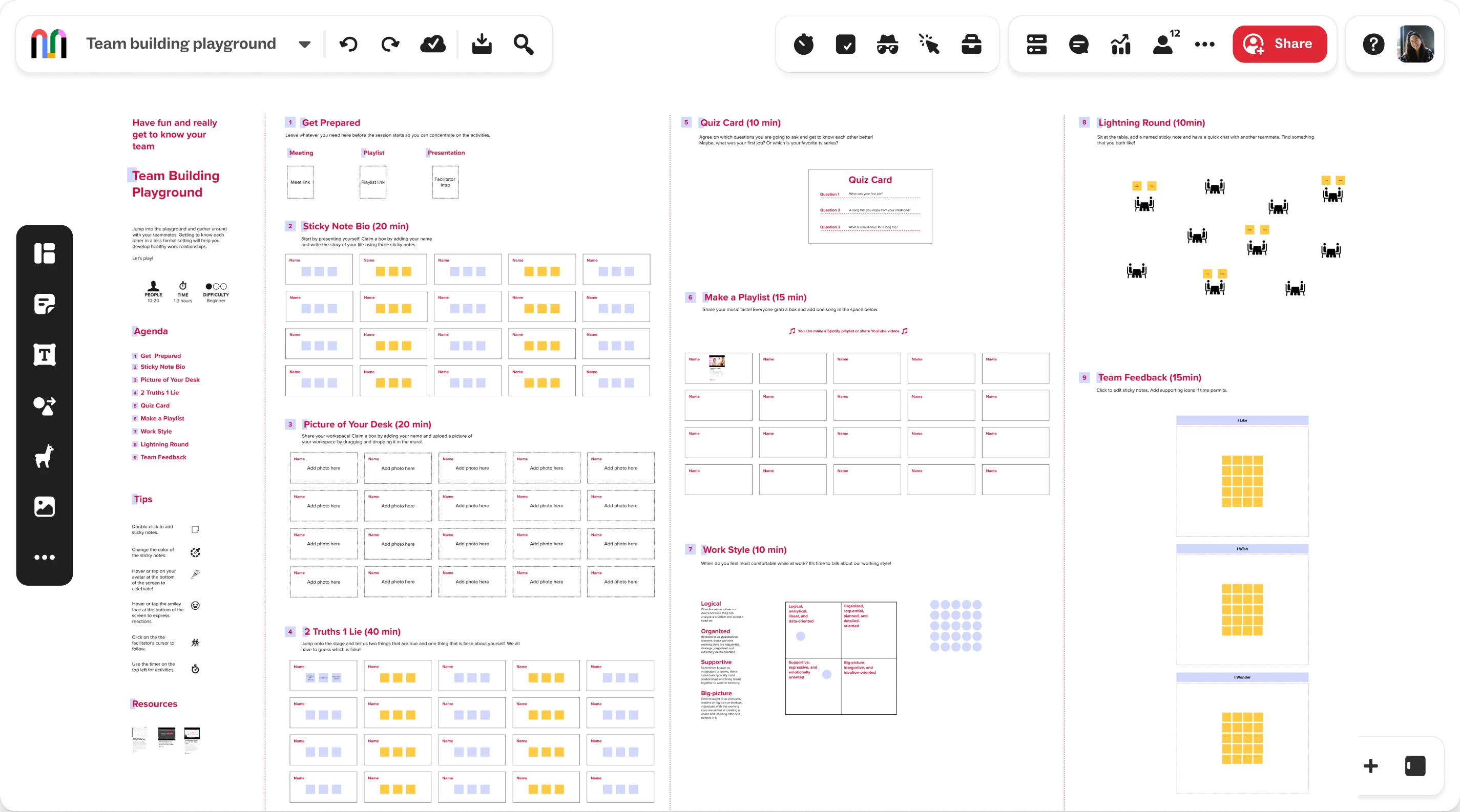
Strong team building activities create opportunities for people to understand one another and practice how they want to work together. Keeping those contributions visible makes it easier to carry what the team learns into the work that follows. For broader support, explore what to look for in team collaboration software.
Give your team a shared space to connect, contribute, and work better together. Sign up for free to get started.


