


Meeting intelligence helps teams move beyond meeting notes to understand decisions, coordinate next steps, and maintain alignment after conversations end.
Most meetings contain useful information. The challenge is that information alone does not guarantee shared understanding. AI notetakers and meeting assistants have made it easier to capture what happened during a discussion. But capturing information is only the first step.
We’ve all seen firsthand how the ideas and plans that seemed coherent and clear during a meeting somehow become frayed and foggy afterwards. It’s not anyone’s fault; it’s just a natural result of how most meetings unfold. People join late, or they miss it altogether. Everyone interprets discussions differently. Action items get lost, priorities shift, and teams find themselves revisiting conversations they thought had already been resolved.
Meeting intelligence helps teams understand what was decided, identify priorities, and coordinate action within the larger context of a project or campaign.
Meeting intelligence is the next evolution of AI meeting assistants
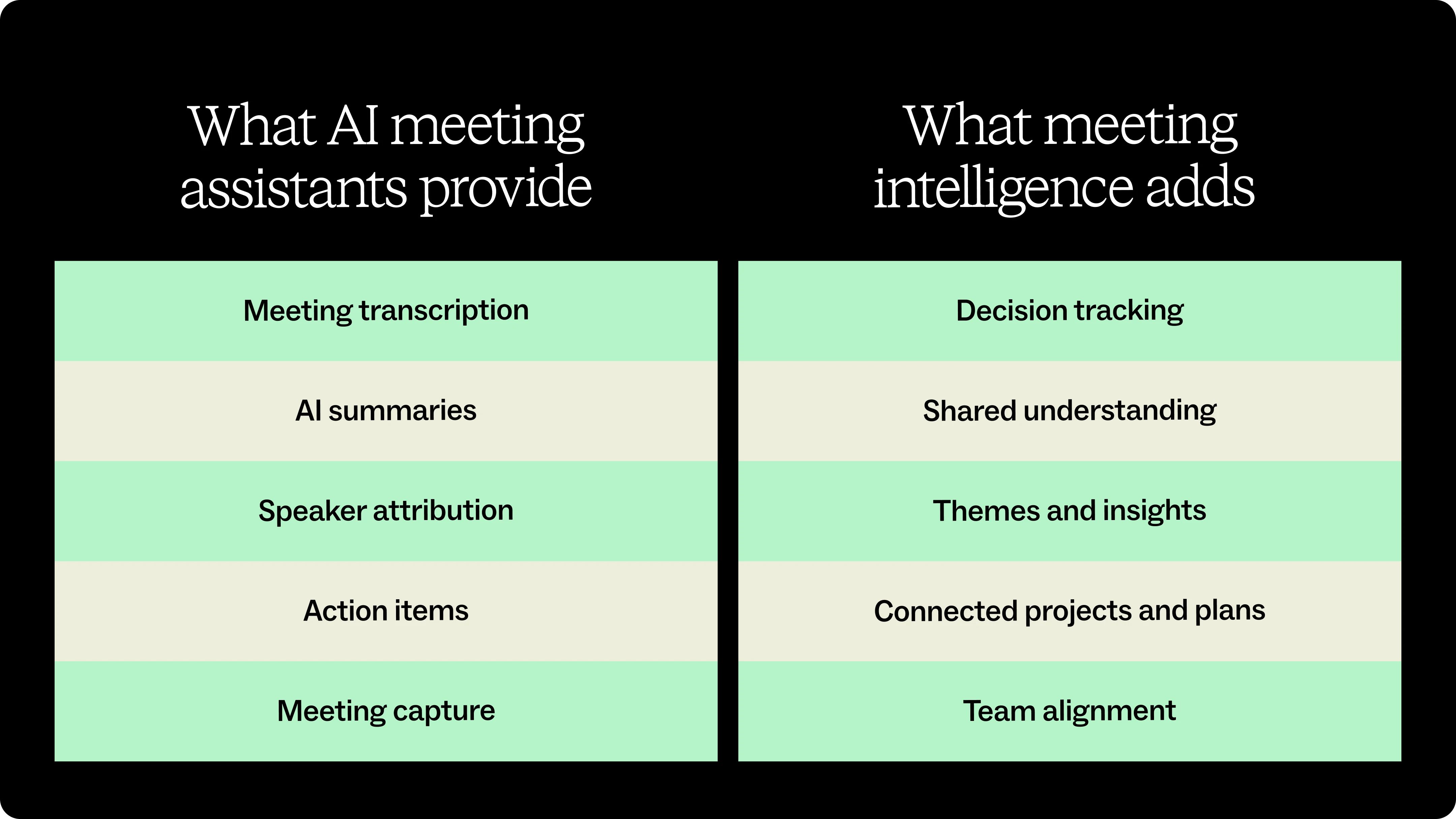
AI meeting assistants focus on capturing conversations through transcription and summaries. Meeting intelligence builds on those capabilities by helping teams understand what decisions were made, why they matter, and how they connect to ongoing work.
Meeting intelligence typically includes:
- meeting transcription
- AI-generated summaries
- speaker attribution
- action items and next steps
- decision tracking
- themes and patterns
- collaboration after the meeting
The goal is not simply to document conversations, but also to help teams use them to coordinate action.
As organizations spend more time collaborating across functions and locations, the need for shared understanding becomes increasingly important.
How meeting intelligence builds on AI meeting assistants
AI meeting assistants document conversations, creating transcripts as well as summaries and highlights. Meeting intelligence builds on those capabilities to help teams understand decisions, identify priorities, and coordinate action.
AI notetakers and meeting assistants are valuable because they preserve information that might otherwise be lost. But notes and summaries alone do not guarantee that everyone is actually aligned on what to do next and how to do it.
How meeting intelligence improves decision-making
Meeting intelligence improves decision-making by making it easier for teams to understand discussions, clarify ownership, and connect decisions to action.
When people have access to the same information and interpretation, they spend less time revisiting conversations and more time executing.
Meeting intelligence can help organizations:
- improve visibility into decisions
- reduce rework
- strengthen accountability
- speed up alignment across teams
- improve collaboration between stakeholders
Why meeting notes alone don’t create team alignment
A transcript records what happened. Alignment requires clarity about what happens next.
Most people do not leave meetings with identical takeaways. The meeting ends and people return to their work. A week later, priorities have shifted, stakeholders remember different things, and nobody is entirely sure who owns the next step.
One person may think a decision has been made, but another thinks the issue is still open. Someone else may assume a task belongs to another team. One thing we see all the time is where individual teams are working hard on their pieces of the puzzle, but without a clear view of project dependencies. By the time blockers surface, they are likely already causing bottlenecks.
The result is familiar:
- the same discussions happen again
- responsibilities become unclear
- priorities drift
- work gets duplicated
- decisions become fragmented across notes and documents
Meeting notes are useful, but they’re only one part of the process. Teams need a shared understanding of what was decided, why it matters, and who is responsible for moving things forward.
Without that, information stays trapped inside transcripts and summaries.
This happens across workstreams and use cases:
- In product planning sessions, teams debate priorities again because the original reasoning is difficult to reconstruct.
- In customer research, valuable insights become buried inside transcripts and recordings.
- In executive reviews, action items remain vague and accountability becomes unclear.
- In sales strategy meetings, participants leave with different interpretations of customer concerns and competitive risks.
Meeting intelligence reduces this ambiguity by making important information easier to understand, share, and act on.
From meeting summaries to action
Most AI meeting tools stop at transcription and summaries. That is useful, but the real challenge begins after the meeting ends.
Organizations already have systems of record, systems of analysis, and systems of action. What they often lack is a way to create shared understanding between those systems.
Teams need ways to connect conversations to plans, priorities, and decisions, aligning around outcomes. This is exactly where meeting intelligence becomes valuable.
The goal is not simply to remember what was said. It is to ensure that discussions lead somewhere by clarifying decisions and supporting ongoing collaboration.
Why connected intelligence matters
Meeting insights become more valuable when they are connected to the rest of the organization, because conversations don’t happen in isolation.
When information remains frozen inside meeting notes, teams lose opportunities to build on what they already know. Connecting meeting insights to broader organizational knowledge helps teams maintain continuity across projects and improve collaboration between functions.
Connecting conversations to plans, projects, and decisions
Teams constantly connect information from multiple sources.
Customer feedback influences product priorities. Research findings affect strategic plans. Executive decisions shape projects and roadmaps.
Meeting intelligence ensures these relationships are visible and accounted for.
Through Mural's MCP-powered ecosystem, meeting insights can connect to plans, projects, customer feedback, and organizational knowledge, helping teams maintain alignment and execute with greater confidence.
Instead of treating meetings as isolated events, organizations can turn conversations into part of a larger body of knowledge that supports ongoing work.
How Mural Compose turns conversations into action
Mural Compose starts with the capabilities teams expect from an AI meeting assistant: transcription, speaker attribution, summaries, and action items.
Then it goes further.
Mural Compose captures the conversation that anchors a decision, attributes insights to the people who shared them, and turns that context into shared visual artifacts on the canvas where the team already works. Affinity diagrams, journey maps, dependency boards, and action-item canvases appear while the discussion is still fresh, giving teams something they can review and build on together.
The output is not another transcript buried in someone's inbox. It is a shared artifact that preserves the reasoning behind decisions and keeps context visible as work moves forward.
The end of solo AI means meeting insights no longer belong to the person who happened to take notes. They become something the entire team can see, discuss, and act on.
The result is better alignment, stronger decisions, and faster execution.
To learn more about AI-powered collaboration, visit Mural AI.
%20(3).jpg)

%20(1).webp)


