

.jpg)
Giving employees access to AI is easy. Building an organization that knows how to use it well is harder.
Sustainable adoption depends on more than tools and training. People need to know how to evaluate AI outputs, apply judgment, experiment with new approaches, redesign workflows, and learn from one another.
So, how do you build AI capabilities across your organization? Develop AI literacy and critical thinking, human-AI collaboration, experimentation and problem-solving, AI-enabled ways of working, leadership capabilities, and continuous learning. Then give people opportunities to apply those capabilities to real work.
AI capability is built through learning, experimentation, and application, not training alone.
What is AI capability building?
AI capability building is the ongoing process of developing the skills, behaviors, practices, and ways of working that enable people and teams to use AI effectively.
Training can teach someone how to use a tool. Capability building prepares them to decide when to use it, evaluate what it produces, adapt it to a real business problem, and improve the workflow over time.
At an organizational level, this expands individual learning into repeatable ways of working that teams can share and improve.
Organizations need to:
- Develop skills that apply beyond a single AI product
- Connect learning to real roles and workflows
- Give teams opportunities to practice and experiment
- Share useful practices across functions
- Adapt as AI capabilities and business needs change
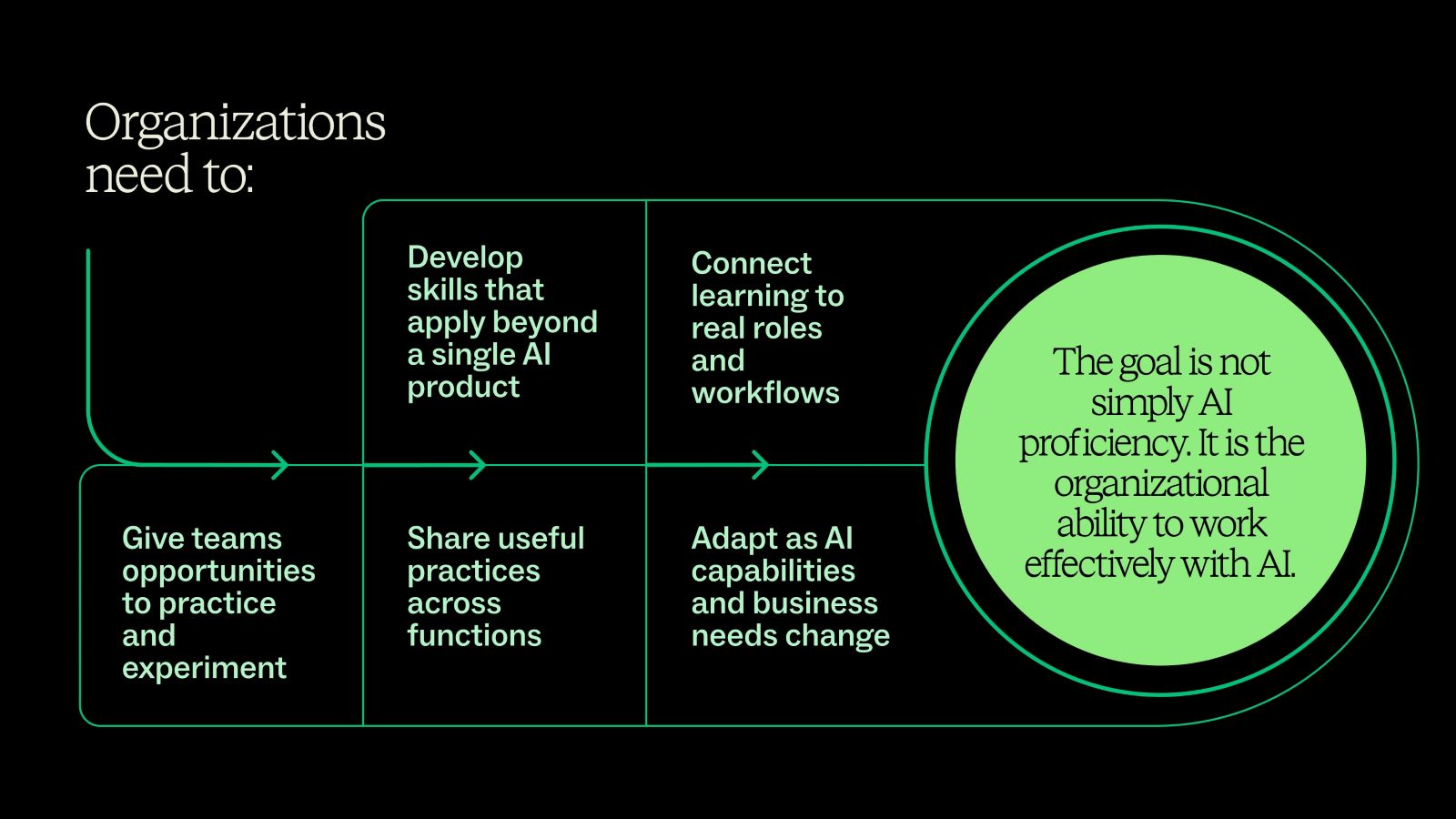
What AI capabilities do organizations need?
Organizations need systems to empower their people with the judgment to decide how AI should fit into their work, while teams need shared practices that turn individual skill into collective capability.
AI literacy and critical thinking
Employees need enough understanding to use AI appropriately, recognize limitations, verify outputs, and apply human judgment.
Human-centered AI collaboration
Effective AI adoption requires teams to understand what AI can contribute and where human judgment remains essential.
AI can organize information, generate starting points, synthesize context, and accelerate repetitive work. People still interpret results, weigh tradeoffs, and make decisions.
As AI agents take on larger parts of workflows, teams also need to decide how people and agents contribute to shared work, not just how individuals use AI alone.
Experimentation and problem-solving
AI capability grows when people test it against meaningful problems.
Rather than asking, “Where can we use AI?” start with a workflow or friction point and ask where AI could improve the work.
This problem-first approach makes experimentation useful. Teams can test an idea, review the result, identify where human intervention mattered, and apply what they learned to the next iteration.
AI-enabled ways of working
Organizations also need to move beyond isolated AI tasks.
One employee might use AI to generate a summary, another to analyze research, and another to draft a plan. But if those outputs remain disconnected, the team still has to rebuild shared context.
AI-enabled ways of working create shared practices for reviewing, refining, and acting on AI-generated work together.
Leadership and change capabilities
AI can change roles, workflows, and expectations, so leaders need to make that change understandable.
They should clarify where experimentation is encouraged, where guardrails apply, and what good AI use looks like. They also need to create room for teams to learn rather than expecting instant proficiency.
Leaders play an important role in turning local experiments into shared organizational practices.
Continuous learning and adaptability
AI capabilities will keep changing, so AI skills development can’t be a one-time initiative.
Teams need mechanisms for reflection, peer learning, experimentation, and adaptation. The ability to keep learning may ultimately matter as much as proficiency with any particular tool..
How to build AI capabilities across your organization
The strongest AI capability-building programs connect learning to actual work. People develop practical judgment by using AI on real problems, reviewing the results, and improving their approach.
Identify what different teams actually need
Avoid treating AI capability as one universal skill set.
A researcher evaluating AI-generated synthesis needs different skills from an engineering leader working with agents or a facilitator preparing a workshop.
Start with important roles and workflows, then ask:
- What work could AI meaningfully change?
- What decisions will employees need to make?
- Where will human judgment remain critical?
- What skills or behaviors are missing today?
This turns generic AI training into capability development tied to real work.
Connect learning to real business problems
Generic examples can introduce a concept, but capability develops through application.
Give teams real problems to work on: synthesizing research, preparing a strategy session, improving a handoff, organizing customer feedback, or exploring possible solutions to a business challenge.
The key question becomes less “Did we use AI?” and more “Did this improve the work?”
Give people opportunities to practice
AI upskilling requires repetition.
Employees need room to try different approaches, compare results, identify failure modes, and build their own judgment about what effective AI use looks like.
This is central to LUMA's learning-by-doing approach. A workshop can introduce a method, but repeated application turns it into a capability.
Encourage experimentation within clear boundaries
Teams should understand which systems are approved, what information can be shared, what outputs require verification, and when additional review is necessary.
Within those boundaries, employees need enough freedom to discover useful applications.
Teams should also capture what they tried, what worked, where human intervention mattered, and whether the approach is worth repeating.
Make learning collaborative
Much AI learning happens individually. Employees experiment in private chats and develop their own techniques.
Organizations need to make that learning visible.
Teams can compare approaches, review AI-generated outputs together, discuss where judgment was required, and share effective practices across roles.
Collaborative learning turns individual skill into shared capability.
Capture and share successful practices
When an experiment improves a workflow, capture the lesson.
That might become a reusable template, checklist, facilitation approach, example, or workflow pattern another team can adapt.
The goal is not to standardize every experiment. It is to make useful knowledge portable.
Equip leaders to support the change
Leaders need enough AI capability to evaluate opportunities, guide tradeoffs, and support experimentation.
They also need to recognize that changing a workflow can affect roles, responsibilities, collaboration patterns, and measures of success.
AI capabilities are strengthened through practice. Give people opportunities to apply AI to real work, learn from experience, and improve together.
How to sustain and scale AI capabilities across teams
Once teams begin developing AI capabilities, the next challenge is making learning cumulative.
Create communities for peer learning
Bring together people actively applying AI in their work so they can compare workflows, discuss failures, and demonstrate practical applications.
Peer learning gives employees access to examples grounded in the organization's own work.
Develop champions and internal facilitators
AI champions can connect central strategy with local practice.
They do not need to be the most technical people in the organization. They need to understand the work, guide experimentation, and help teams learn from one another.
Turn experiments into reusable approaches
When teams discover a useful practice, make it easier for others to adopt.
Capture where the approach works, how it works, and what human judgment it requires. Templates, examples, and workflow patterns can give teams a tested starting point.
Build reflection into AI-enabled work
After an experiment or project, ask:
- Where did AI improve the work?
- Where did it introduce friction or uncertainty?
- What required the most human judgment?
- What would we do differently next time?
- What should another team reuse?
These conversations turn everyday work into continuous AI skills development.
Keep evolving the capability
There is no permanent finish line for enterprise AI capabilities.
As AI changes, organizations need to revisit their assumptions, practices, skills, and workflows.
AI capability building is an ongoing organizational practice, not a one-time training program.
Build your organization's AI capabilities with LUMA
Organizations do not create sustainable AI transformation simply by deploying more technology. They create it by changing how people understand AI, exercise judgment, solve problems, collaborate, and learn.
LUMA takes a human-centered approach to that change, helping organizations build practical AI skills, redesign workflows, strengthen human judgment, develop shared ways of working, and build the internal capability to keep improving as AI evolves.
Mural provides the shared workspace where teams can put those capabilities into practice. Teams can make ideas and information visible, collaborate around shared context, evaluate AI-generated contributions together, and turn individual inputs into decisions and action.
LUMA develops the human capabilities and ways of working organizations need to succeed with AI. Mural gives teams a collaborative workspace to apply and strengthen those capabilities together.
%20(3).jpg)
%20(1).webp)


