

.avif)
Brainstorming sessions can unlock creative solutions, align cross-functional teams, and surface ideas that might otherwise go unheard. But successful brainstorming doesn't happen by accident. Without clear goals, thoughtful facilitation, and a structured process, even the most enthusiastic teams can leave a session with scattered ideas and no clear path forward.
Whether you're leading an in-person workshop, a hybrid meeting, or a fully remote collaboration, your role as facilitator is to create the conditions for productive idea generation. That means helping participants understand the challenge, encouraging broad participation, selecting the right brainstorming method, and guiding the group from exploration to action.
In this guide, you'll learn how to facilitate a brainstorming session from start to finish, including how to prepare your team, choose the right brainstorming techniques, keep discussions productive, and ensure your best ideas don't end when the meeting does.
What makes a brainstorming session successful?
A successful brainstorming session isn't measured by the number of ideas on the board. It's measured by whether the session helps the team explore new possibilities, build on one another's thinking, and leave with clear next steps.
Effective facilitators focus on creating an environment where people can contribute openly while providing enough structure to keep the conversation moving. The goal is to encourage creativity without letting discussions lose direction.
The strongest brainstorming sessions typically share a few characteristics:
- A clearly defined challenge or question
- The right mix of participants and perspectives
- Ground rules that encourage psychological safety
- A brainstorming method that matches the problem
- A clear plan for organizing, prioritizing, and acting on ideas
Preparation is often the difference between a brainstorming session that feels energizing and one that feels unfocused. Before participants begin generating ideas, they should understand why they're there, what problem they're solving, and how success will be measured.
The five steps to facilitating an effective brainstorming session
Every team approaches brainstorming differently, but the most effective sessions follow the same general flow. By preparing thoughtfully, guiding discussion with the right techniques, and following through afterward, facilitators can help teams generate more useful ideas while keeping everyone engaged.
The five steps are:
- Prepare your brainstorming session
- Frame the challenge clearly
- Create the conditions for productive collaboration
- Facilitate idea generation with the right method
- Turn ideas into action
Let's look at each step in more detail.
Step 1: Prepare your brainstorming session
Successful brainstorming begins well before anyone starts writing ideas on sticky notes. Preparation helps participants arrive with a shared understanding of the problem, the right expectations, and the tools they need to contribute.
While brainstorming should encourage creativity, the session itself shouldn't feel improvised. The more thoughtfully you prepare, the more freedom your team has to focus on generating ideas instead of figuring out the process.
Create a clear agenda
A simple agenda helps participants understand what to expect and keeps the session on track without limiting creativity.
A typical brainstorming agenda might include:
- A brief introduction and objective
- Context for the challenge or opportunity
- A warm-up activity or icebreaker
- One or more structured brainstorming exercises
- Time to review, group, and discuss ideas
- Next steps and action items
Timeboxing each activity helps maintain momentum while giving everyone an opportunity to contribute.
Related: How to create effective meeting agendas
Define what success looks like
Before inviting participants, ask yourself what you want the session to accomplish.
For example, are you trying to:
- Generate as many ideas as possible?
- Improve an existing process?
- Prioritize potential solutions?
- Explore opportunities from multiple perspectives?
- Identify risks before launching a new initiative?
Clarifying the desired outcome makes it easier to choose the right brainstorming method later in the session.
Instead of asking participants to "brainstorm marketing ideas," define a challenge such as:
How might we encourage more trial users to become active customers during their first week?
Specific challenges produce more focused and actionable ideas than broad topics.
Invite the right participants
One of the biggest predictors of a successful brainstorming session is having the right people in the room.
Diverse perspectives often lead to stronger ideas because participants approach problems from different experiences and areas of expertise. Consider including people from multiple teams, levels of seniority, or customer-facing roles when appropriate.
At the same time, resist the temptation to invite everyone. Smaller groups are often easier to facilitate and give participants more opportunities to contribute.
Before the meeting, make sure everyone understands:
- The purpose of the session
- The challenge they'll be addressing
- Any pre-reading or preparation required
- What decisions, if any, will be made afterward
Related: How to empower introverts to contribute in meetings
Choose the right collaboration space
Brainstorming works best when everyone can see, organize, and build on ideas together.
For in-person sessions, that might mean a whiteboard, sticky notes, and markers. For distributed or hybrid teams, a shared digital workspace allows participants to contribute simultaneously regardless of location.
A collaborative workspace should make it easy to:
- Capture ideas quickly
- Group related concepts
- Rearrange information as discussions evolve
- Vote or prioritize ideas
- Save the results for future reference
Using a shared digital canvas also makes it easier to revisit ideas after the meeting instead of recreating them from handwritten notes.
Select your facilitation tools in advance
Good facilitators remove unnecessary friction before the meeting begins.
That means testing technology, preparing templates, and deciding how participants will contribute before the session starts.
If you're facilitating in Mural, for example, you can prepare a workspace with templates, timers, Private Mode for individual ideation, and voting activities already configured. This allows participants to focus on solving the problem instead of learning new tools during the workshop.
Preparation also extends to facilitation itself. Think through where participants may need additional guidance, where discussions could drift off topic, and how you'll encourage quieter voices to contribute alongside more vocal team members.
The best facilitators don't control the conversation. They create the conditions that allow everyone else to contribute their best thinking.
Step 2: Define a clear objective
The quality of a brainstorming session depends largely on the quality of the problem you're asking people to solve. A vague prompt leads to scattered ideas, while a well-framed challenge gives participants enough direction to think creatively without narrowing their options.
Before the session begins, define the problem in language everyone can understand. Avoid assuming shared context or jumping straight to potential solutions. Instead, explain why the challenge matters, what success looks like, and any constraints participants should keep in mind.
For example, compare these two prompts:
Too broad
"Let's brainstorm ways to improve onboarding."
More effective
"How might we help new customers experience value within their first seven days?"
The second prompt gives participants a clear objective while leaving plenty of room for creative thinking.
Use "How might we..." questions
Many facilitators use How might we... questions because they encourage exploration rather than debate.
Good prompts are:
- Specific enough to focus discussion
- Open-ended enough to encourage multiple solutions
- Written from the user's or team's perspective
- Centered on an outcome rather than a predetermined solution
Examples include:
- How might we reduce handoff delays between Sales and Customer Success?
- How might we make our onboarding process easier for first-time users?
- How might we encourage more participation during team retrospectives?
If your team begins suggesting solutions before fully understanding the problem, pause and return to the challenge statement. A few minutes spent refining the question often produces significantly better ideas later.
Related: 25 brainstorming questions you should ask to generate better ideas.
Step 3: Set ground rules, give context and establish parameters, and define key terms
With your topic outlined, it’s time to establish the parameters and scope of the brainstorm, as well as define key terms. Again, the more you can do to ensure that everyone enters the session well informed and with a shared understanding of the problems and goals, the more productive your meeting will be.
Examples of ground rules:
- Quantity over quality: Remind your participants that the goals will include collecting as many ideas as possible
- No judgment: Don’t criticize your colleagues’ ideas, and ask for clarification before giving feedback
- Everyone’s ideas count: Make your brainstorming session visual, so that everyone can more easily participate and ideas can be organized into themed categories
Related: Simple Ground Rules for Brainstorming
Encourage equal participation
In many brainstorming sessions, a handful of participants dominate the discussion while others contribute very little. As a facilitator, one of your most important responsibilities is balancing participation across the group.
There are several techniques that help.
Start with silent ideation
Give participants five to ten minutes to write ideas independently before opening discussion. This approach, often called brainwriting, reduces groupthink and allows quieter team members to develop ideas before hearing everyone else's opinions.
Invite contributions intentionally
Instead of asking, "Does anyone have another idea?" invite individuals or smaller groups to share what they've generated.
Separate idea generation from evaluation
Resist the urge to critique ideas as they're shared. Early evaluation often discourages creative thinking and narrows discussion before enough possibilities have emerged.
Keep the session moving
Long discussions around individual ideas can quickly drain a brainstorming session's energy.
Instead, keep activities short and focused.
Some practical techniques include:
- Timeboxing each exercise.
- Giving participants visible countdown timers.
- Capturing ideas without debating them.
- Parking unrelated topics for later discussion.
- Summarizing progress before moving to the next activity.
If energy begins to fade, introduce a new exercise rather than extending the current one. Changing formats often helps participants see the problem from a fresh perspective.
Step 4: Facilitate idea generation with the right method
When you're ready to begin, leverage your chosen brainstorming framework to help guide your team and get the most out of your session.
Choose a specific approach
Having established an agenda, a shared space, a topic, and ground rules for your brainstorming session, the next phase is to determine the best method. Structure boosts creativity, so the more clearly you outline your strategy and tactics, the better your results will be.
Also, there are specific methods that are ideally suited to particular scenarios.
For example, if you’re trying to set up a brainstorming session that tackles a new problem that has a lot of associated variables, a mind map brainstorm is likely to be the best technique.
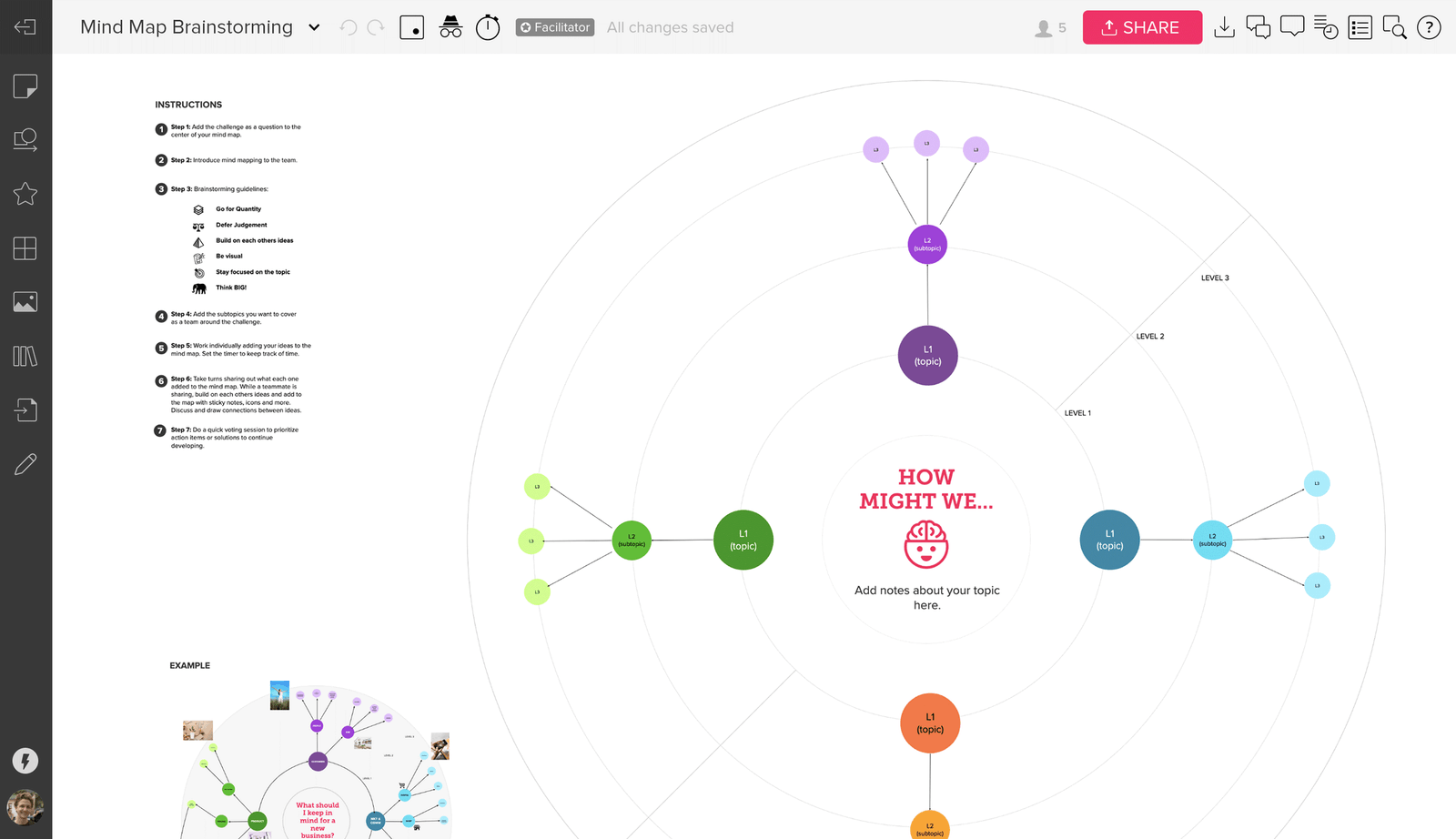
Using the mind map technique, you begin by placing the core problem you’re trying to solve in the center, and then build outward as you brainstorm all of the variables and related ideas. These can be organized by their level of influence.
If instead you’re looking to have your teammates build upon one another’s ideas so that the results are as collaborative as possible, then the Round Robin technique may be the best option.
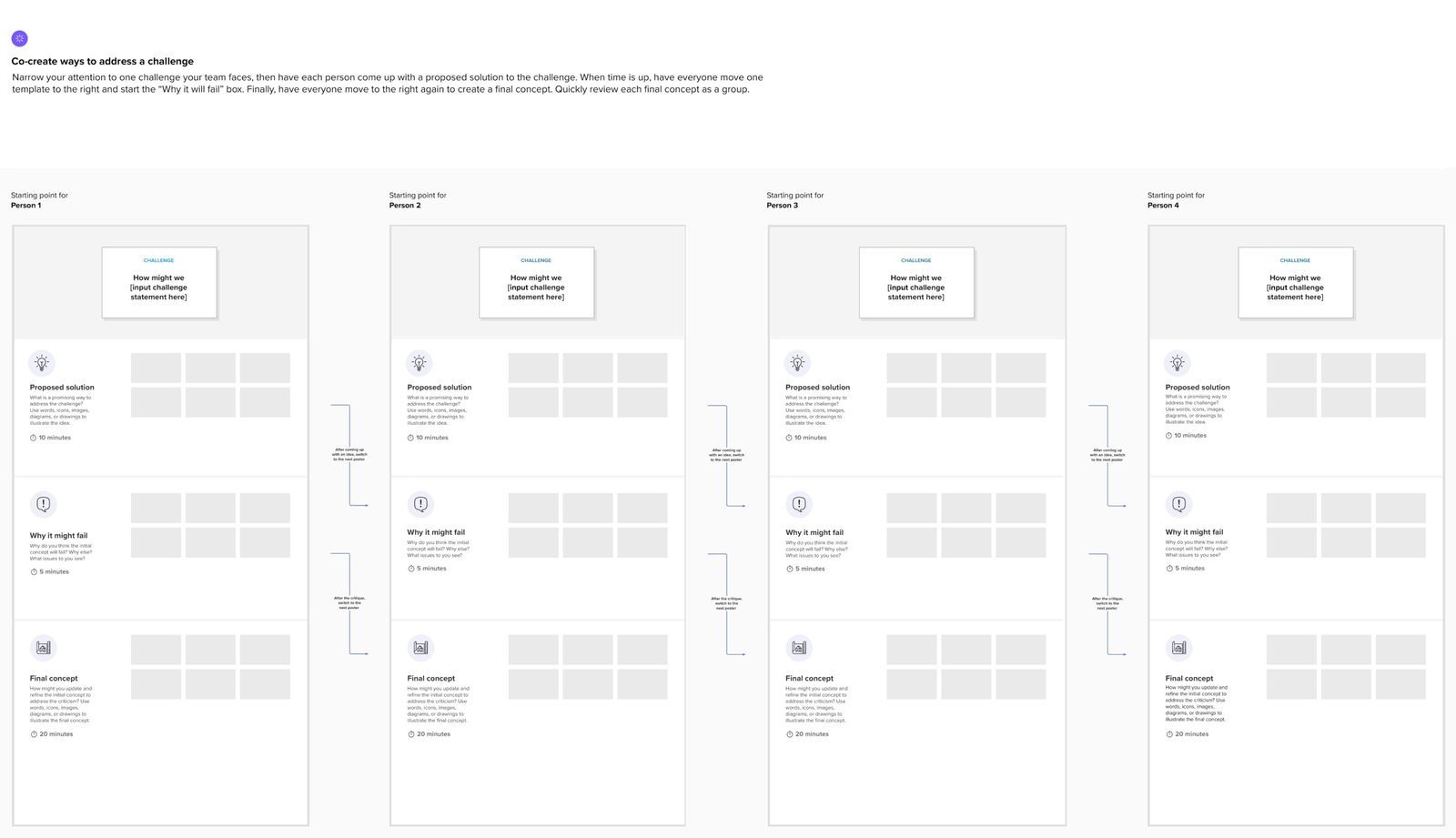
With the Round Robin approach, team members are asked to not only contribute new ideas, but also build upon the ideas of their colleagues, resulting in multi-layered suggestions and (likely) more holistic solutions.
Related: Brainstorming Techniques for Better Idea Generation
Use AI to enhance brainstorming, not replace it
AI can help facilitators generate ideas more efficiently, but it works best as a creative partner rather than a decision-maker. The facilitator is still responsible for providing context, encouraging participation, and helping the team determine which ideas deserve further exploration.
Used thoughtfully, AI can reduce blank-page anxiety, introduce fresh perspectives, and accelerate common facilitation tasks without replacing human judgment.
Here are a few practical ways to incorporate AI into your brainstorming workflow:
Generate starting prompts
If participants are struggling to get started, AI can suggest initial ideas, alternative perspectives, or "How might we..." questions that spark discussion.
Rather than treating AI output as final answers, use it as a catalyst for conversation.
Explore different perspectives
Ask AI to generate ideas from the viewpoint of different stakeholders, such as:
- A first-time customer
- A power user
- A support representative
- An executive sponsor
- A competitor
This technique helps teams move beyond their own assumptions and uncover opportunities they may have overlooked.
Cluster and summarize ideas
Once a brainstorming session produces dozens or even hundreds of ideas, AI can help identify recurring themes, summarize similar suggestions, or recommend categories for affinity mapping.
This can significantly reduce the time required to organize large brainstorming sessions while allowing facilitators to focus on discussion instead of manual sorting.
Draft next steps
After the session, AI can help transform brainstorming outputs into:
- Meeting summaries
- Action-item lists
- Decision logs
- Follow-up questions
- Project briefs
The facilitator should always review these outputs to ensure they accurately reflect the team's decisions and priorities.
Step 5: Turn ideas into action
When the brainstorming component of your meeting has come to an end, it’s time to bring everyone back together and analyze your findings so that you can craft constructive next steps.
Using a shared digital space and online sticky notes makes it easier to collate and organize your ideas — color coding, tags, and groupings help visualize different themes or categories that can form the basis for solutions. With all your ideas at hand, you can begin the process of assigning tasks, setting deadlines, and establishing metrics for future analysis.
Generating ideas is only half the job. The real value of a brainstorming session comes from what happens afterward.
Without a clear process for reviewing, prioritizing, and acting on ideas, even the most energetic session can end with participants wondering what happens next.
A good facilitator helps the group transition from exploration to execution.
Organize ideas into themes
Before evaluating ideas individually, group related concepts together.
This process, often called affinity mapping, helps teams identify recurring patterns, common opportunities, and areas where multiple ideas point toward the same solution.
As participants organize ideas, ask questions such as:
- Which ideas solve similar problems?
- What themes are emerging?
- Are there opportunities to combine ideas?
- Which concepts deserve additional exploration?
Seeing ideas visually grouped often reveals connections that weren't obvious during brainstorming.
Prioritize together
Once ideas are organized, the group can begin deciding which opportunities deserve attention first.
Depending on your goals, prioritization might involve:
- Dot voting
- Anonymous voting
- Impact-versus-effort matrices
- Opportunity scoring
- MoSCoW prioritization
- RICE or other prioritization frameworks
Using a structured prioritization method keeps decision-making transparent and prevents the loudest voices from dominating the outcome.
Digital collaboration tools can make this process especially efficient by allowing participants to vote simultaneously and immediately visualize the results.
Assign ownership
Brainstorming creates momentum. Assigning ownership preserves it.
Before ending the session, make sure participants understand:
- Which ideas will move forward
- Who owns each next step
- What success looks like
- When progress will be reviewed
Clear ownership transforms brainstorming from a creative exercise into meaningful progress.
Capture the work
The session shouldn't disappear when everyone closes their laptops.
Save your workspace, document key decisions, and share a summary while the discussion is still fresh.
A useful recap includes:
- The original challenge
- Major themes
- Prioritized ideas
- Decisions made
- Open questions
- Action items
- Owners and due dates
When brainstorming outputs remain visible and accessible, future teams can build on previous work instead of starting from scratch.
Brainstorm better with Mural
With a suite of features and tools built specifically for collaboration and brainstorming, Mural is the best way to engage with your team, visualize and organize your ideas, and craft actionable next steps.
Get started with Mural today and invite your team into a collaborative brainstorming workspace. Use templates, AI-powered features, and guided methods to turn ideas into action and help your team uncover the next big opportunity.
%20(1).avif)


