


In the words of Steve Farrell, our VP of global marketing: “If you’re doing marketing without a business goal, you’re just lighting money on fire.”
Marketing campaigns should line up with your business strategy. But maybe marketing leadership didn’t have time to sync up with sales leaders. Or a campaign needed to move quickly because of a new competitor or tech advancement. Or the marketing campaign was for brand awareness, but the business needed quick sales. Sometimes strategies don’t line up.
Getting clear on how marketing campaigns line up with business goals isn’t just a task to check off your list. It can completely change the outcome of your efforts.
Why aligning marketing campaigns with business strategy matters
Steve thinks about effective marketing campaigns this way:
“What is the story we’re telling in our marketing? And how is sales telling them? There’s sometimes wildly different stories being told, with product, marketing, and sales understanding the customer in three completely different ways. Marketing telling a consistent story can help with alignment.”
John Graham, our head of account management, agrees: “A lot of sales leaders will tell you one of the biggest areas of opportunity they have is to better engage with marketing. There tends to be misalignment between those two teams…their metrics don’t align, which creates friction.”
When your marketing and business goals are in sync, every dollar spent and message shared can lead to measurable results and a return on investment. Plus, you’ll more likely prioritize high-impact initiatives, break down team silos, and keep the focus on your customers.
Sync your marketing campaign planning with your business goals by:
- Create a unified message. Tell a clear story via marketing campaigns to create a single message from all departments, and make sure marketing efforts are in sync with your business’s goals.
- Define goals that support broader business objectives. If your business goal is to increase market share, your marketing campaign may focus on customer acquisition.
- Create key performance indicators (KPIs). Track metrics like sales growth, customer acquisition cost, and return on investment to make sure the campaign hits its targets.
- Collaborate across departments. Everyone should work closely together to contribute to the same goals and a seamless customer experience.
Key components of a great marketing campaign strategy
Everyone has their favorite marketing campaign. Steve loves the Old Spice guy on a horse: “It’s a well-crafted campaign because it was going for the non-obvious truth,” he says, about who really buys bathroom products.
Let’s use Old Spice’s “The Man Your Man Could Smell Like” as a quick example to think through the key components of a campaign:
- Goals: Increase brand awareness and boost sales of Old Spice products.
- Audience: Target both men and women (who might purchase products for men), aged 18-35, who appreciate silly advertising and attractive people.
- Create content: Develop a series of funny commercials featuring a hot guy on a horse, wittily charming the audience.
- Choose channels: Use television commercials, YouTube videos, social media, and other digital marketing channels.
- Track progress: Check metrics like video views, social media engagement, brand mentions, and sales figures and adjust campaigns based on real-time feedback and data to maximize impact.
With lots of people to coordinate, and many steps in the process, keep things simple by pulling together your plan in one place.
Using Mural to create your marketing campaign
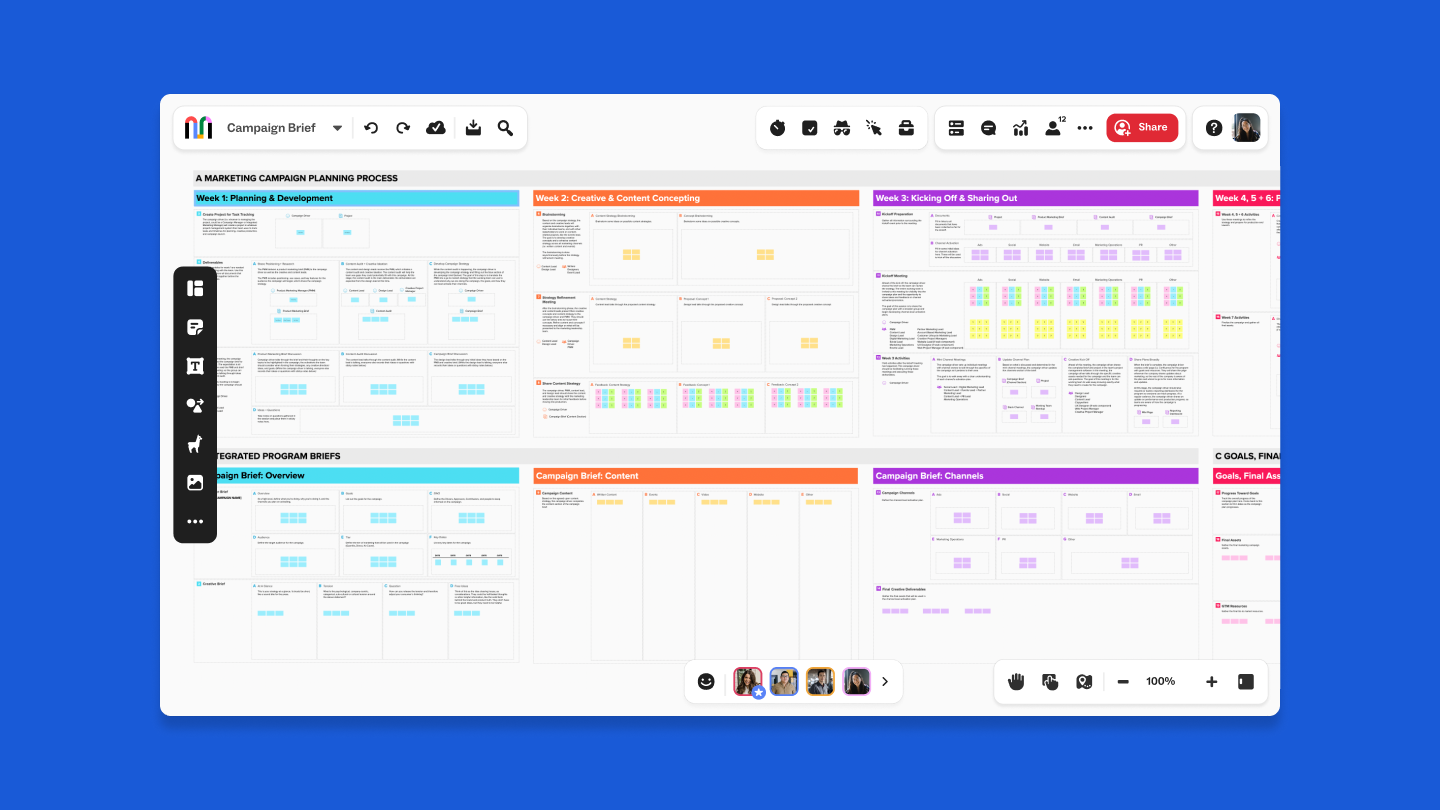
As a marketing leader, Steve believes a single visual space makes campaign planning much easier:
“Mural allows you to capture a single source of truth in the clearest and most direct way. Seeing is believing: ‘Look, here’s the campaign. Here’s the target audience. Here is what we’re saying to them. Here are the assets; here are the results.’ You scan it, you see it, it's done. You can do that in other forms, but none are as clear and quick as Mural.”
We whipped up a template for marketing campaign planning to make it simple for you to lead campaign planning and work across teams. The template has more details, but here’s a quick walk through.
Step 1: Plan for your marketing campaign using Mural
Before you get to work, spend some time preparing.
Gather your team. Include people from different departments (like sales) to offer additional perspectives. Line up your campaign leader, project manager, content lead, design lead, and other important people. Clearly define roles and responsibilities and decide how you’ll collaborate.
Tip: Consider building a team agreement to clarify working norms.
Collect resources. Put all relevant documents, research, and data about your campaign in one mural. Make sure your product marketing manager shares research, positioning, use cases, target audience, and key features.
Tip: Tag sales, finance, product using comments to have them drop info in the mural.
Write briefs. Share an overview to keep others looped in on how the campaign is progressing. Explain the campaign’s purpose, target audience, intended channels, core messaging, and initial creative ideas.
Tip: Add visuals like gifs or images to bring the plan to life.
Track metrics. Track your campaign KPIs in a dashboard, and link to these in your mural. Add business goals, like increase sales by 3.5%” and “increase overall brand engagement.”
Get feedback on the strategy. Meet with key stakeholders to review your campaign’s goals, target audience, content strategy, and channel activation plans.
Tip: Make instructions for giving feedback fun and simple, like “Positives on purple stickies, please!”
Step 2: Start creative and content brainstorming
Brainstorm as a team. Make your content strategy and creative sessions as energizing as the outputs! Try a themed meeting (our team recently ran a tea party-themed meeting) or pull a brainstorm template for something already designed.
Refine your strategy. Polish your content strategy and creative concepts with the core team. Double-check that your approach is cohesive across all marketing channels, including written content, events, and visuals.
Tip: Try running a vote in private mode if folks need to get on the same page.
Step 3: Share the campaign with others
Schedule a meeting to share. When you’re ready for more feedback from the larger group, set up a time to meet. Consider including people like:
- Project management and coordination
- Content strategy
- Design and creative
- Digital and channel activation
- Operations
- Marketing leadership
- Cross-functional groups like sales and customer success
Send prework in advance of the meeting. Plan for your meeting in advance. Have the team review the mural and key elements of the campaign. Consider recording a video walk-through, and specify how you want folks to share their thoughts and reactions, or re-aligning on the overall marketing strategy.
Tip: Add reflective questions in the mural to help guide the team, like “What’s missing? What excites you?”
Run an organized live session. During a live meeting, walk through the campaign plan, and collect feedback. Take advantage of the time together to brainstorm ideas for channel activation across platforms like ads, social media, and PR. The outcome of this meeting should be to make sure your promotional strategy supports company objectives and brand visibility.
Step 4: Execute the campaign
Draft creative and content. Create content and get feedback easily in a mural. Create and review visuals, write copy, develop event concepts, and produce content in a single collaborative space.
Tip: Use the outline feature to label each section and make it easy to navigate.
Get feedback from leadership and stakeholders. When you’re ready for final review and approval, present your mural to your leadership team and other stakeholders. There might be multiple rounds of revisions with so many voices, so plan accordingly. Keep everyone on track with clear instructions and deadlines.
Tip: If sharing live, use presentation mode.
Enable your go-to-market team. When assets are finalized, share the plan and materials with your sales and customer success teams. Don’t forget to announce it to the rest of the company too! Get people excited and drum up some energy.
Run a retrospective. Take time to gather with the team to celebrate wins, learn from mistakes, and make decisions about where to improve.
Best practices for consistent alignment in cross-functional teams
Marketing campaign planning involves a ton of collaboration. John explains why it’s easier with Mural:
“Running a marketing campaign is a big cross-functional effort. The ability for teams to come together and work asynchronously drives a lot of efficiency. Mural drives sales and marketing alignment because it’s such a great planning tool. When you get two teams that are doing campaign planning and objective alignment, working visually is a really good venue for prioritizing ideas and objectives, and driving outcomes.”
With 75% of collaboration in marketing happening remotely, don’t forget these important best practices for hybrid and virtual teams:
- Run regular standup meetings to maintain communication and track progress.
- Use project management tools to track task progress, resources, and hold task owners responsible.
- Watch the campaign’s effectiveness with performance reporting and make adjustments as you go.
- Collaborate and request feedback throughout the process to stay aligned to company goals and stay focused on results.
Try Mural with your marketing team
Great marketing campaigns know their audience, have clear goals, engaging content, strategically use channels, and optimize based on data. Pull together your next campaign using Mural’s free campaign planning template.


