

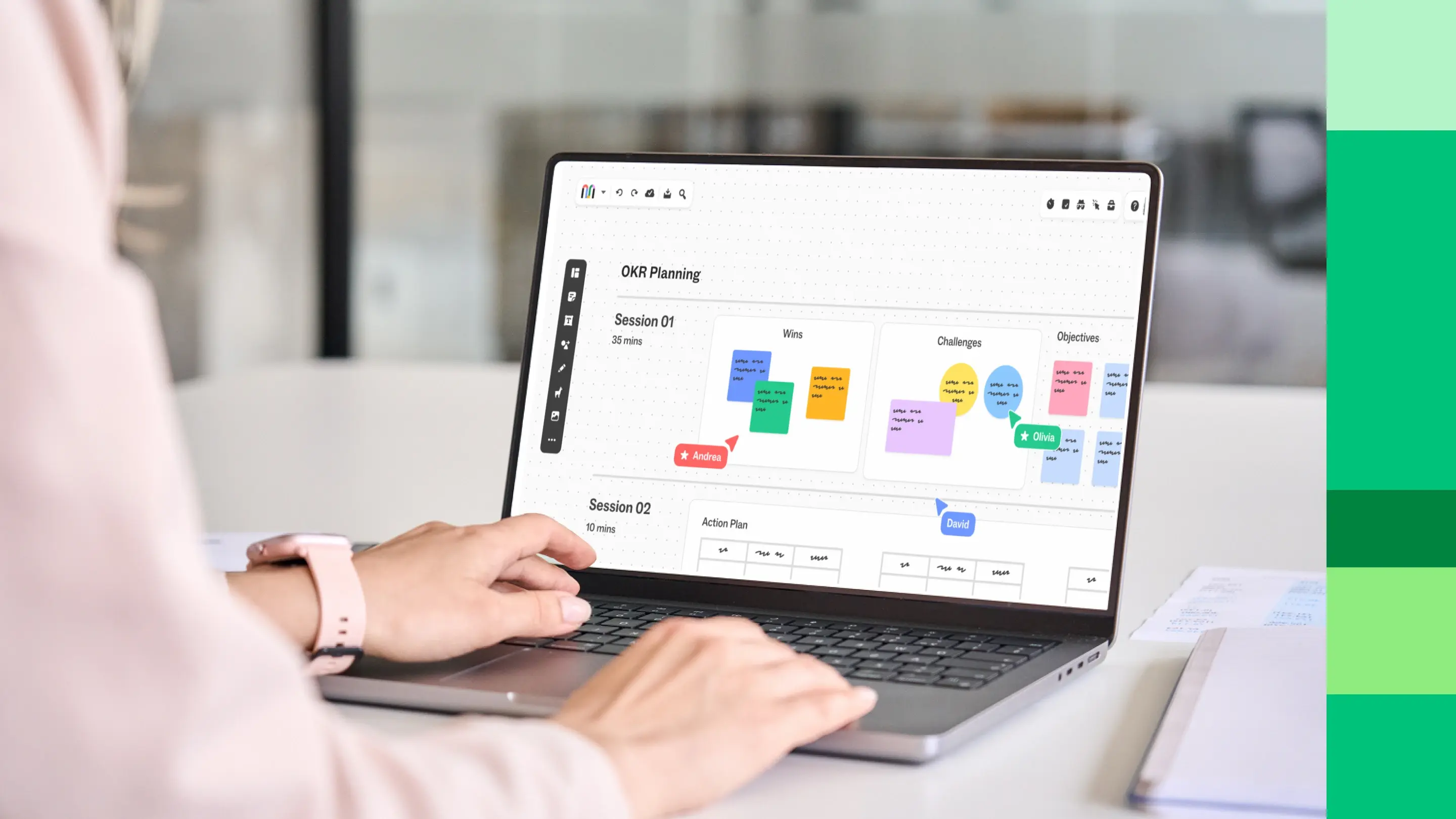
Enterprise collaboration has moved far beyond messaging, file sharing, and getting more done individually. Cross-functional teams need to make sense of complex information together, explore ideas, align on priorities, make decisions, and translate those decisions into action, often across locations and time zones.
A strong enterprise collaboration platform needs to support more than one moment of teamwork. It should give people a place to work through complexity together, support different collaboration styles, and make effective practices easier to repeat across the organization.
Enterprise teams choose Mural because it combines visual collaboration, AI-powered workflows, structured ways of working, and enterprise-scale capabilities in one workspace.
If you're still evaluating what matters in a platform, start with this guide to choosing the right enterprise collaboration platform. If you're evaluating Mural specifically, here's what makes it a strong choice for collaboration and innovation at enterprise scale.
Why enterprise teams choose Mural
Enterprise teams choose Mural to make ideas visible, build shared understanding, facilitate more productive working sessions, and create repeatable approaches that extend beyond a single meeting.
Mural for enterprise combines several of those needs in one collaborative workspace:
- A visual canvas where teams can organize information, explore ideas, and work toward shared understanding
- Real-time and asynchronous collaboration for distributed and cross-functional work
- Templates and structured methods that make common workflows easier to repeat
- AI capabilities that accelerate collaborative creation, synthesis, and organization while keeping people in control
- Enterprise security, governance, access management, and administrative capabilities
- Adoption and enablement support for expanding effective ways of working across teams
A workshop does not have to end as a collection of disconnected notes. A planning exercise can become a shared view of priorities and next steps. Research can move from individual analysis into an artifact a team can challenge, refine, and use to make decisions.
That progression from individual contribution to shared understanding, alignment, and outcomes is what turns a collaboration tool into a workspace for getting important work done.
Improve collaboration across the organization
Enterprise work rarely happens within a single function. Product teams depend on engineering. Strategy teams need input from leaders and operators. Researchers bring customer insight into planning. Program managers connect work across all of them.
Mural gives those groups a shared visual canvas where people can contribute together instead of working through a chain of separate documents, messages, and presentations.
In a live session, participants can add ideas, organize information, respond to one another, and see the work develop in real time. When schedules or time zones do not overlap, teammates can return to the same canvas asynchronously, add context, review decisions, and continue the work without starting over.
Visual organization also changes the nature of participation. Instead of relying only on whoever speaks first or most often, teams can collect contributions before grouping, discussing, and prioritizing them. A planning canvas can bring goals, risks, dependencies, feedback, and next steps into one shared view.
The result is collaboration with a visible record of how the team got from discussion to direction.
Turn ideas into decisions and action
Generating ideas is rarely the hardest part of enterprise work. The challenge is deciding what matters, building agreement across stakeholders, and translating that agreement into action.
A visual workspace makes that progression easier to see.
Teams can start by brainstorming possibilities, gathering research, or mapping a complex problem. From there, they can organize related ideas, identify themes and dependencies, compare options, and bring the right stakeholders into the decision.
The same canvas can then capture priorities, owners, and next steps, creating continuity between collaborative thinking and execution.
For enterprise teams, this is especially useful when strategy and delivery involve multiple functions. Instead of treating strategy, planning, and execution as separate conversations, Mural gives teams a shared environment for connecting them.
Support innovation with visual and AI collaboration
Enterprise innovation depends on more than generating more ideas. Teams need to explore possibilities, make complex information understandable, build on one another's thinking, and determine which ideas deserve action.
Visual frameworks give teams structure for that work. They can use canvases to map customer journeys, synthesize research, explore systems and processes, brainstorm alternatives, or break a large problem into parts. Templates and guided activities provide a starting point without forcing every team to design its process from scratch.
Mural AI extends that workflow by bringing generation and synthesis into the collaborative canvas. With the Mural MCP compatible AI agents can read and write to a Mural canvas, bringing context from the tools they already work with into a shared visual environment.
Build repeatable ways of working
The best workshop your organization ever ran has limited value if nobody can reproduce it.
Enterprise teams need ways to turn effective collaboration practices into repeatable habits. Mural supports that by giving teams reusable templates, visual frameworks, and guided approaches for common activities such as planning, ideation, research synthesis, problem-solving, and decision-making.
Instead of starting every workshop or planning cycle with a blank canvas, teams can reuse structures that already work. Departments can adapt shared approaches to their own needs while maintaining a recognizable process across the organization.
Mural's LUMA offering adds structured methods for collaborative problem-solving and facilitation. Teams can use established methods to guide how they explore problems, generate possibilities, develop understanding, and move toward decisions.
This makes innovation less dependent on a single facilitator or one-off workshop. Effective practices can be documented, shared, reused, and improved as more teams adopt them.
Over time, people spend less time inventing the mechanics of collaboration and more time working on the problem in front of them.
Scale collaboration with enterprise confidence
Enterprise-wide collaboration introduces requirements that do not exist when a tool is used by a small team.
Organizations need confidence that they can manage access and users, apply governance practices, integrate collaboration into their existing technology environment, and support adoption across a large and distributed workforce.
Mural combines the collaborative canvas with enterprise security, governance, administration, and access-management capabilities designed to support broader organizational use. Those controls give teams room to collaborate while giving enterprise leaders a foundation for managing the platform at scale.
Technology alone does not create adoption, however. Organizations also need people to understand how and when to use a new workspace. Implementation, enablement, and ongoing support can make the difference between scattered pockets of use and repeatable practices that spread across departments.
Mural Accelerate helps organizations expand effective use of Mural across their teams, scaling both the platform and the practices to work effectively together.
What makes Mural different from other enterprise platforms?
Many enterprise collaboration products solve a specific part of the work: communication, project tracking, documentation, meetings, or digital whiteboarding.
Mural combines a visual collaborative workspace with structured ways of working, AI capabilities, and enterprise support designed around how teams think and decide together.
That combination gives organizations a way to:
- Make complex work visible instead of leaving context scattered across tools
- Bring real-time and asynchronous contributors into the same collaborative environment
- Apply structured methods to planning, problem-solving, and innovation
- Bring AI-generated work into a space where teams can review and refine it together
- Turn collaborative sessions into decisions, priorities, and next steps
- Establish repeatable ways of working across teams
- Support broader adoption with enterprise governance and enablement
Enterprise collaboration is ultimately an outcomes problem. More communication does not automatically create alignment. More individual productivity does not guarantee a better team decision.
When compared with other collaboration tools, Mural is more focused on outcome enablement. Mural gives people and AI a shared canvas where contributions become visible, teams build understanding around them, and that understanding can move toward alignment and action.


