


When it comes to making decisions as a team, finding a process that encourages equal participation, minimizes bias, and leads to clear outcomes can be challenging. That’s where the Nominal Group Technique (NGT) comes in.
Originally developed to improve group decision-making, NGT offers a structured method for gathering ideas, prioritizing input, and reaching consensus — without the usual pitfalls of groupthink or dominant voices.
Let’s explore how the nominal group technique works, when to use it, and how it can boost collaboration across teams of any size. Whether tackling a complex problem or just wanting to ensure every voice is heard, NGT provides a powerful framework for structured, inclusive dialogue.
In this blog, you will learn:
- How NGT ensures equal participation and helps prioritize outcomes in team decision-making.
- The step-by-step process of the nominal group technique, including idea generation, sharing, voting, and reaching consensus.
- How NGT differs from brainstorming in its structured approach and focus on equal input and prioritization.
- The pros and cons of NGT, and when is the best time to use it.
- How tools like Mural can simplify the NGT process by enabling real-time collaboration and efficient session management.
What is the nominal group technique?
The Nominal Group Technique (NGT) is a structured method for group brainstorming that encourages contributions from everyone and helps a team quickly reach a prioritized decision.
Unlike open discussions where louder or more dominant voices can take over, NGT ensures that every participant has an equal opportunity to share their ideas. It’s especially useful for problem-solving, decision-making, and gathering a wide range of input in a short amount of time.
Here’s how it typically works:
- Silent idea generation – Each person writes down their ideas individually and silently.
- Round-robin sharing – One by one, participants share one idea at a time, which is recorded (usually on a board or screen) without discussion.
- Clarification and discussion – Once all ideas are shared, the group discusses each item for clarity, not to debate.
- Ranking or voting – Each participant ranks or votes on the ideas, and the group tallies the scores to prioritize them.
This method is called “nominal” because, while it’s a group process, much of the idea generation is done individually — helping reduce groupthink and bias.
Ready to get started? Use this template to kick off your nominal group technique session:

Brainstorming vs. nominal group technique: Key differences
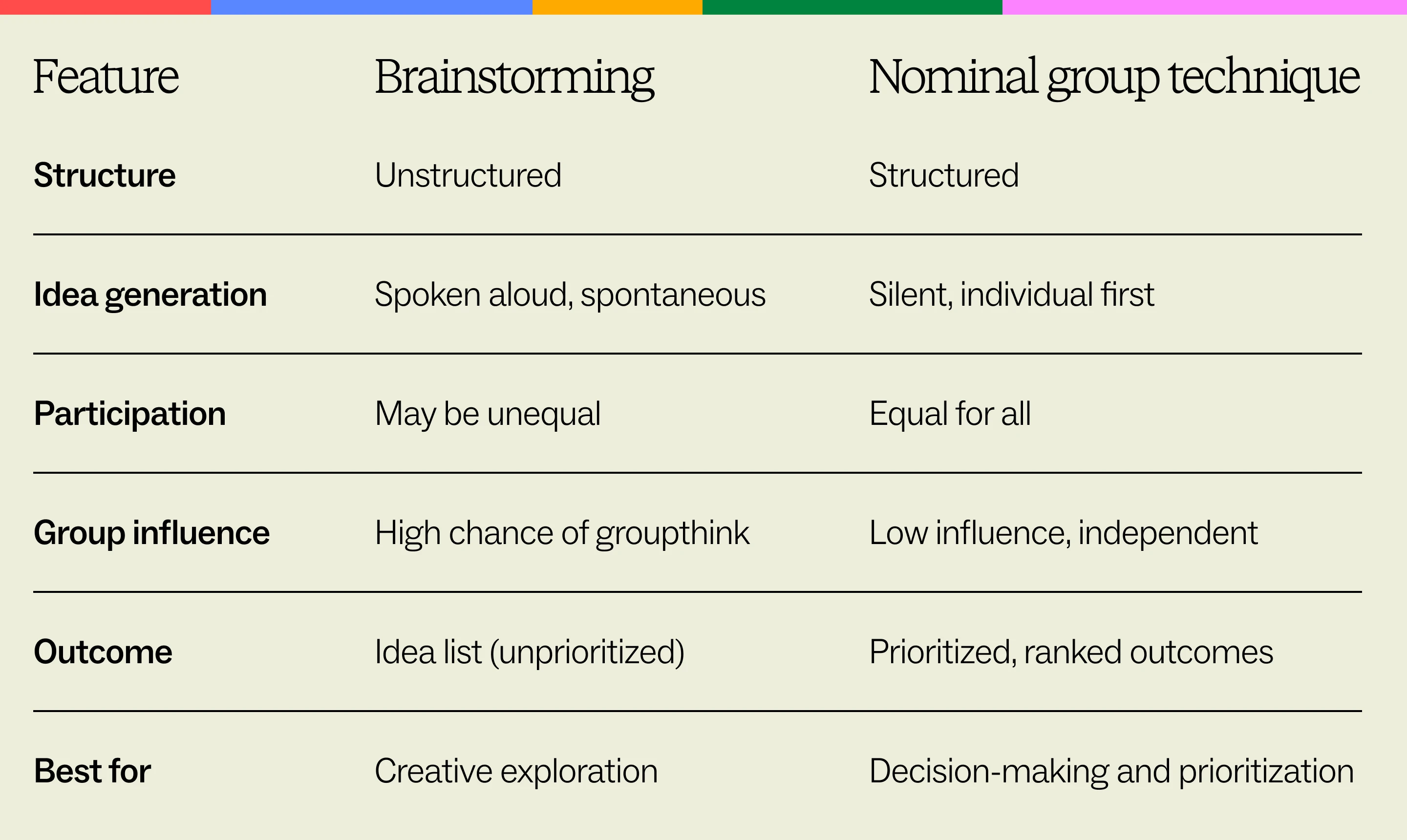
While both brainstorming and the nominal group technique (NGT) are used to generate ideas in group settings, they differ quite a bit in structure, participation, and outcomes.
Here’s a clear breakdown of the key differences:
1. Structure
Brainstorming: Informal and free-flowing. People shout out ideas as they come, and discussion happens in real time.
NGT: Highly structured. Ideas are generated silently first, then shared in an orderly, round-robin format, followed by clarification and voting.
2. Participation
Brainstorming: Can be dominated by louder or more confident participants. Quiet team members may hold back.
NGT: Everyone has an equal opportunity to contribute. Silent idea generation levels the playing field.
3. Idea generation
Brainstorming: Group members build on each other’s ideas in the moment, which can lead to creativity — but also groupthink.
NGT: Ideas are created independently first, which reduces peer influence and allows for more diverse input.
4. Decision-making
Brainstorming: Often ends with a long list of ideas, but no clear prioritization unless an additional process is used.
NGT: Includes a built-in ranking or voting system, so the team ends with a prioritized list of ideas or actions.
5. Best used when…
Brainstorming: You want rapid idea flow, spark creativity, or warm up a group.
NGT: You need equal input from all members, avoid bias, and reach a consensus or make a decision.
Nominal group technique pros and cons
The nominal group approach is a structured method designed to encourage equal participation and produce clear, prioritized outcomes — making it especially useful in settings that demand collaboration and focus.
Whether you're working in Agile project management, conducting strategic planning, or tackling complex problem-solving sessions, knowing when to use the nominal group technique can help you unlock better group decisions.
Let’s explore the benefits of the nominal group technique, as well as some potential drawbacks, so you can decide if it’s the right fit for your next prioritization challenge.
Pros
- Equal participation: NGT ensures that every voice is heard, not just the loudest ones. Since everyone writes down ideas individually, quieter or less dominant team members get just as much input as others.
- Reduces groupthink: By generating ideas silently and independently before group discussion, NGT minimizes peer pressure and conformity, leading to more diverse and creative suggestions.
- Clear prioritization: Unlike regular brainstorming sessions, NGT ends with a ranked or voted list of ideas — which makes it easier to identify the most important or popular options right away.
- Time-efficient: The structured format keeps the session focused and productive. You move quickly from idea generation to decision-making without endless discussion or debate.
- Encourages collaboration and consensus: By combining individual input with group discussion and collective voting, NGT helps build buy-in and consensus — everyone sees how decisions are made.
- Repeatable and scalable: NGT works well in both small and large groups and can be used across industries — from healthcare and education to business and nonprofits. It’s easy to replicate for different problems.
- Highlights unique ideas: Because ideas are generated in isolation first, people are less influenced by others, and more likely to offer original or unconventional suggestions that might not emerge in a typical group chat.
Cons
- Time-intensive with larger groups: Can be time-consuming, especially with larger groups due to the structured steps involved.
- Requires skilled facilitation: Needs a trained facilitator to effectively manage the process and ensure fairness throughout the session.
- Limited spontaneity: Restricts real-time collaboration and idea-building during the initial silent brainstorming phase.
- Surface-level idea exploration: Focuses on generating and ranking ideas quickly, which may limit deeper analysis of complex topics.
- Less flexible for informal settings: May feel too rigid or formal for creative brainstorming, casual team discussions, or fast-moving Agile workflows.
Key steps of the nominal group method
The nominal group method follows a clear, step-by-step process designed to promote equal participation and structured decision-making. Whether you're leading a workshop, facilitating a strategic planning session, or managing team input in an Agile environment, understanding these core steps will help you guide the group from idea generation to actionable outcomes.
- Introduction
The facilitator welcomes participants to the NGT meeting, explains the purpose of the session, and presents the main question or problem to be addressed.
Related: Top 10 dos and don’ts for effective facilitation
- Idea generation
Participants individually and silently brainstorm their ideas on sticky notes in response to the question. This step minimizes group influence and allows for diverse, independent thinking.
- Round-robin sharing
Each participant shares one idea at a time, in turn, while the facilitator records each idea (typically on a whiteboard, flip chart, or shared screen). No discussion occurs at this stage. Mural offers features like a timer and AI clustering to help categorize ideas.
- Group discussion
Once all ideas are listed, the group discusses each one briefly to ensure everyone understands them. Clarification is allowed, but debate or evaluation is avoided.
Related: 5 best practices for better group communication
- Voting
Participants privately rank or vote on the ideas, often assigning point values to their top choices. This step helps prioritize ideas based on group consensus. Use Mural’s anonymous voting feature to keep votes private.
- Consensus
The facilitator collects and totals the votes, presenting the final ranking. The top ideas are then discussed further or used to guide decision-making.
Simplify the nominal group process with Mural
Running an effective nominal group technique session doesn’t have to be complicated — especially with the right tools. Mural, a digital collaboration platform, makes it easy to guide teams through each step of the NGT process, whether you're working in person or remotely. With features like sticky notes, timers, voting sessions, and visual templates, Mural helps facilitators keep the process organized, inclusive, and engaging.
Instead of juggling physical materials or struggling to manage input from multiple participants, Mural allows you to streamline idea generation, organize responses in real time, and instantly tally votes — all in one place. Whether you’re focused on problem-solving, prioritization, or strategic planning, Mural gives you the structure and flexibility to run more efficient nominal group process sessions.
Ready to make your next NGT session more productive and collaborative? Get a demo to experience how Mural can simplify the process for your team.


