


Go-to-market (GTM) teams are expected to operate as one. Marketing, sales, customer success, and product all play different roles, but they’re working toward the same goal: delivering value to customers. In practice, though, these groups often work in silos.
Our research shows why this matters: 85% percent of GTM professionals report frequent struggles with cross-functional misalignment. Not because they lack strategy or intention, but because they lack time. Packed calendars and constant urgency leave little space for creative problem-solving or shared planning.
A sprint creates that space.
A sprint is a focused, time-boxed way to solve a specific challenge together. Originally used in Agile software development, the sprint format has expanded across design, marketing, operations, and strategy — anywhere teams need to make decisions quickly and move forward with confidence.
Why sprints work for GTM teams
Sprints help teams cut through noise and gain clarity fast in a number of ways:
- Focus — You concentrate on one challenge, without distractions.
- Speed — You make meaningful progress in hours instead of weeks.
- Structure — A defined process keeps the team aligned and prevents circular discussions.
- Collaboration — Diverse perspectives surface naturally, helping teams move as one.
But let’s be clear: Sprints aren’t about rushing. They’re about getting aligned quickly so you can execute with purpose.
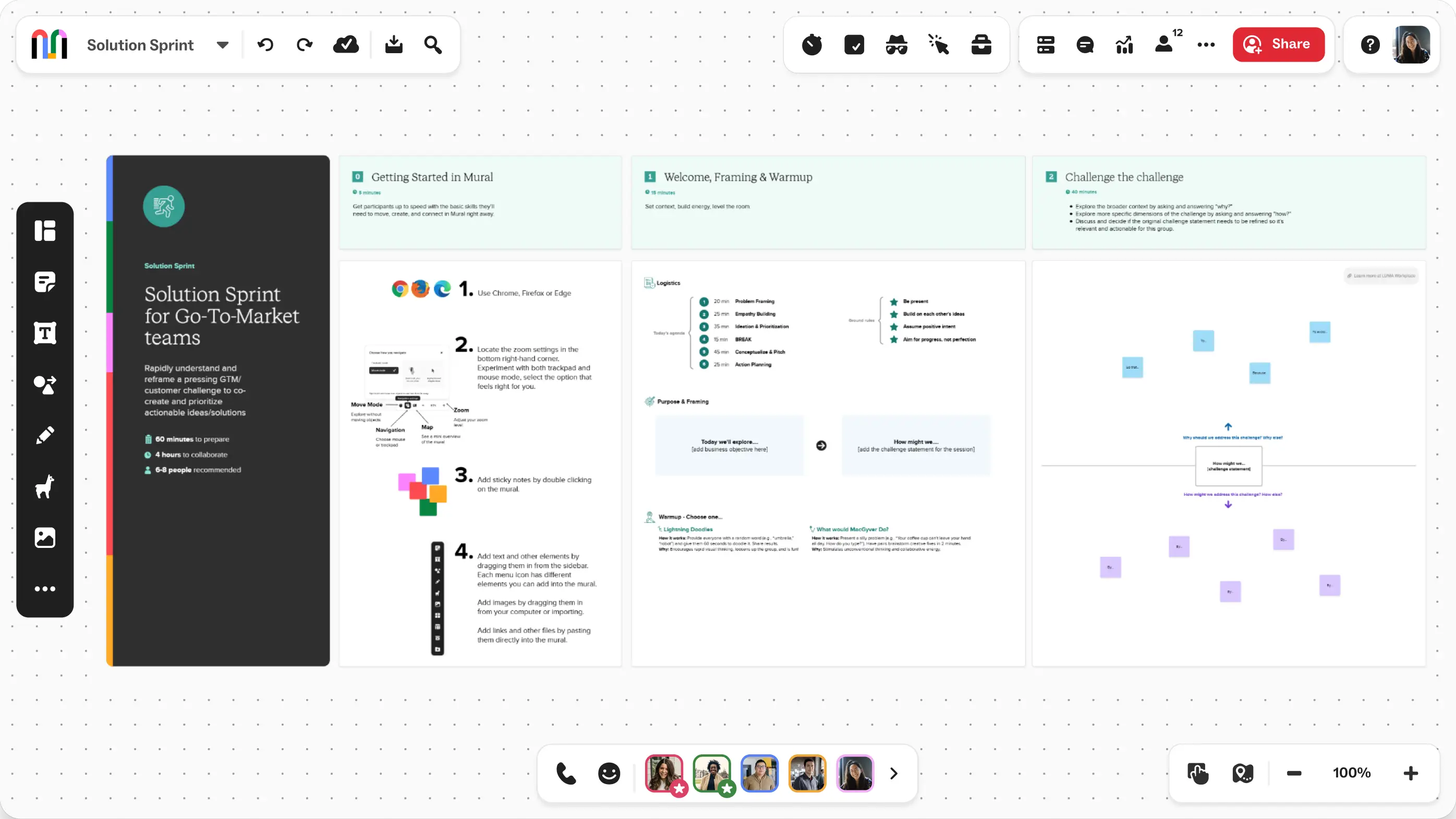
That’s why we created the Solution Sprint for GTM teams — a streamlined, four-hour version of a traditional sprint designed specifically for the pace and demands of modern GTM work.
What’s inside the Solution Sprint
Time: 4 hours
Participants: 5–8
Format: Remote
The experience has three parts: pre-work, sprint session, and follow-up.
Pre-work
Pre-work ensures a team starts from the same baseline. When participants come prepared, the sprint itself becomes more productive and more collaborative.
You can encourage readiness by:
- Blocking calendar time for reading and prep
- Sending a short poll or survey to gather input
- Reserving 10–15 minutes at the start to catch up if your team is still forming async habits
When people arrive aligned, the real work can begin immediately. The aim is to get started before you start in order to maximize your time together.
Sprint session
The Solution Sprint is intentionally fast-paced. Each step builds on the last to help teams solve confidently and efficiently. Here’s the flow of action:
Warm-up and set the stage (15 minutes)
A quick check-in helps people shift attention away from their day and toward the challenge at hand.
Challenge the challenge (30 minutes)
Using an abstraction ladder, the team investigates the problem by asking “why” and “how.” This sharpens the challenge statement and ensures the group focuses on the right issue.
Empathize (20 minutes)
A rapid empathy map captures customer needs, motivations, and pain points. This keeps the conversation grounded in real GTM and customer experience challenges.
Ideate (10 minutes)
With a creative matrix, participants quickly generate a wide range of ideas. Volume matters more than polish here.
Break (10 minutes)
A short reset keeps energy high.
Prioritize (20 minutes)
Using Bullseye and dot voting, the team identifies ideas with the greatest potential based on impact, feasibility, and energy.
Conceptualize solutions (30 minutes)
Teams use a concept poster to turn top ideas into structured concepts with clear logic and benefits.
Pitch and critique (20 minutes)
Each team has three minutes to pitch. The rest of the group offers constructive critique to refine and strengthen the ideas.
Hypothesize (10 minutes)
Teams convert their concept into a testable hypothesis using a simple template that clarifies what they believe and how they’ll validate it.
Conclude (10 minutes)
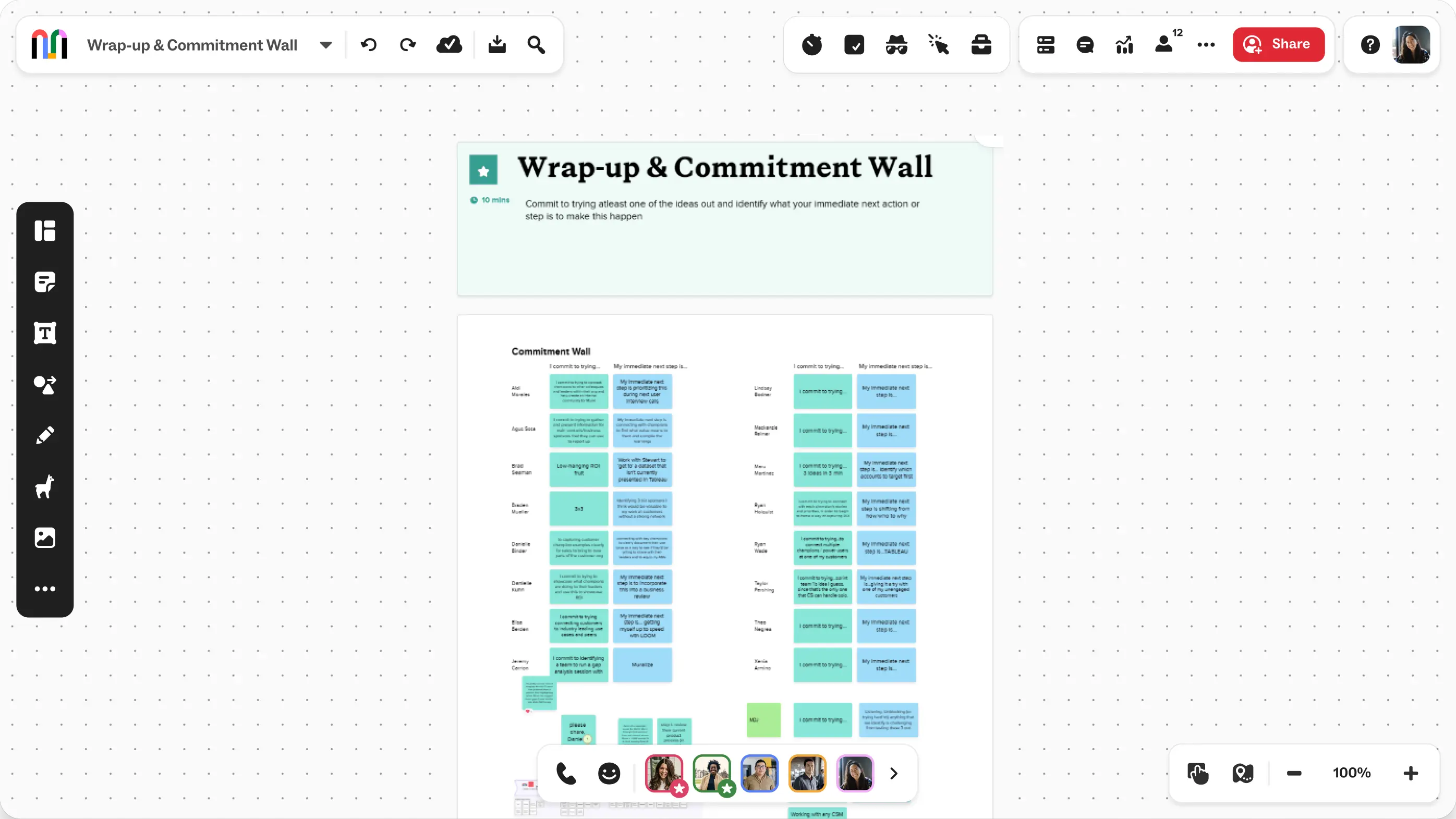
At the end, everyone commits to at least one follow-up action on a commitment wall to ensure clarity and ownership moving forward.
This divergence-and-convergence rhythm helps teams explore possibilities, make informed decisions, and leave with actionable outcomes — together.
Follow-up
A sprint jump-starts momentum, but the follow-up sustains it. You still need to turn your learnings and decisions into results. To avoid “workshop amnesia” — or the tendency to forget what was agreed on as action items during the session — hold a brief session one to two weeks later. This helps teams revisit commitments, identify blockers, share early wins, and realign on next steps
A shared task board or lightweight project tracker keeps everything visible and accountable.
Benefits of the Solution Sprint for GTM teams
A four-hour sprint can deliver breakthroughs that would otherwise take weeks. Here’s what teams gain:
Stronger connection
Solving a challenge together builds trust and strengthens cross-functional relationships.
Better problem-solving
Collective creativity surfaces solutions individuals wouldn’t reach alone.
Clear, actionable outcomes
Teams leave with decisions, next steps, and hypotheses to validate — not more questions.
A more energizing experience of work
The format is fast, collaborative, and engaging. People feel heard, valued, and aligned.
But above all, a sprint creates alignment. It gives GTM teams a shared understanding of the problem, the customer, and the path forward. Run sprints regularly and your team becomes more connected, adaptive, and confident.
Try the Solution Sprint for GTM teams
Or contact us to learn how we can help facilitate your next Solution Sprint for GTM teams
Agenda summary
{{solution-sprint-gtm-teams="/utility/styleguide/cms-tables"}}

_Hero_Image_1440x810.avif)


